Kulsoom Ijaz serves as a senior policy counsel for the legal nonprofit and advocacy organization Pregnancy Justice, which advances and defends pregnant people's rights—no matter if they give birth, experience a pregnancy loss, or have an abortion.
In December 1669, Joane Colledge of Calvert County, Maryland—described in the court record as a “spinster”—was tried on allegations of murdering her newborn. She maintained her innocence and defended herself before a jury, which returned a guilty verdict and sentenced her to death.
Days later, three of the women who had testified in her case, joined by community members, petitioned the court to suspend the execution. The court granted a reprieve, but the archival record leaves the ending a mystery. We do not know whether Colledge was pardoned or executed. But we do know that her story is not all that far from today’s reality for our clients.
In a post-Dobbs world, pregnancy loss is an increasingly suspect occurrence. From 2006 to 2024, Pregnancy Justice has identified more than 160 cases of women charged with crimes related to their pregnancy loss, how they handled the aftermath of pregnancy loss, or for obtaining abortion care. Our recent report “After Pregnancy Loss” identifies and analyzes dozens of criminal laws across the country—many of them centuries old—that govern how people navigate the aftermath of their miscarriage or stillbirth.
These laws have been used to criminalize women for experiences like miscarrying on a toilet, burying their pregnancy loss remains, placing remains in a bag and then a trash receptacle, or even after bringing remains to a hospital. It’s almost as if the point isn’t “justice,” but to respond with disdain to pregnant and postpartum bodies: the fluids, the shedding, the mess, discomfort projected outward and codified into law. This way, the ordinary experience of pregnancy loss becomes criminal.
The engine behind these prosecutions is prenatal personhood, this idea that fertilized eggs, embryos, and fetuses are people, codified to knock women and all people with the capacity for pregnancy down a peg for merely existing. This concept transforms pregnancy loss remains into human “corpses.” It is fiction designed to reimagine products of conception as bodies of deceased people who actually lived. This is how abuse of a corpse statutes—originally intended to punish grave digging and necrophilia—are now wielded against people experiencing miscarriages or stillbirths. Because if a fetus is a human, then pregnancy loss remains are corpses. Even in states with legal abortion or progressive reputations, outdated criminal laws that remain on the books could be used to target the most profoundly devastating and private moments of people’s reproductive lives.
We know that at least one in four known pregnancies end in miscarriage. Even stillbirths, according to a recent Harvard study, are more common than we previously thought, impacting at least 21,000 families annually. One can’t help but wonder what the rates looked like during Colledge’s lifetime, before the advent of modern medicine. Thanks to modern obstetric science, we know that pregnancy loss has very little to do with pregnant people’s behavior, but is brought on by genetic conditions, placental disorders, and infections.
Colledge’s case unfolded within a legal regime that treated women’s sexuality as an opportunity to punish them, especially when pregnancy occurred outside the context of marriage. In the 17th century, English and colonial laws specifically criminalized the concealment of births out of wedlock. At least three of these out-of-wedlock laws are still on the books, in Massachusetts, Michigan, and Rhode Island. When these laws were passed, they reflected the prevailing assumption that unmarried women were motivated by severe social stigma and shame to hide their pregnancies, and by extension, to kill their newborns. These laws emerged in a period when women had few legal rights, when they were subject to coverture—a legal doctrine in which married women had no legal status of their own—and when Black women were also enslaved.
Black women’s bodies were deemed property by enslavers, valued for their capacity to produce children who would sustain the horrific system of enslavement for generations to come. In 1830, there is at least one documented account of an enslaver who accused a woman he enslaved in South Carolina, Sibbey, of deliberately inducing a miscarriage and decreed to “lock her up.” Even pregnancy did not offer protection from violence. When a pregnant woman was whipped, she could be forced to lie face down in a hole in the ground so her abdomen dropped into it, an arrangement designed to “protect” the fetus while enabling the whipping.
And so-called “servant women,” often impregnated by their “masters,” faced corporal punishment ordered by courts of law. Women were far more likely to be prosecuted for crimes like “bastardy” (having a child out of wedlock) and “concealment of a birth” than men. Another crime women were charged with in the 17th century was “running away.” Who could blame them in that world order?
Punishment for women was not subtle. Courts routinely rejected fines as they would have to be paid by men anyway, because women did not have control over finances. Instead, judges quite literally chose public floggings. Women convicted of “bastardy” were stripped down to their waist and whipped before assembled neighbors. The spectacle was intentional, a means to reinforce the social order through pain and humiliation and to send a message to all women watching.
The instruments to punish women with shame and humiliation may have changed, but the instinct to punish has not.
Fast forward to today, women can vote, serve on juries, pursue an education, and become gainfully employed—at least in theory, and for now. They used to have a federal right to abortion care, to chart the course of their own lives, to not be tethered to an abusive partner. But a patchwork of draconian abortion bans makes this impossible in many states, leading to preventable deaths and pregnancy-related arrests. Still, abortion “haven” states try to mitigate harm and take in patients fleeing from around the country to deliver them safe and essential health care.
Centuries ago, the state wounded women’s bodies in public to enforce obedience. Today, it punishes them through arrests, indictments, and mugshots plastered all over the news that trail people for life. Imagine the most traumatic moment in one’s life being broadcast for the world to see, and being reframed as a villain in one’s own tragedy with one’s own body becoming a crime scene. The instruments to punish women with shame and humiliation may have changed, but the instinct to punish has not. When the law cannot tolerate the unknown of pregnancy, it turns to blame. We should be honest about what these prosecutions are: not justice, but a refusal to accept that some aspects of the human condition are beyond our control.
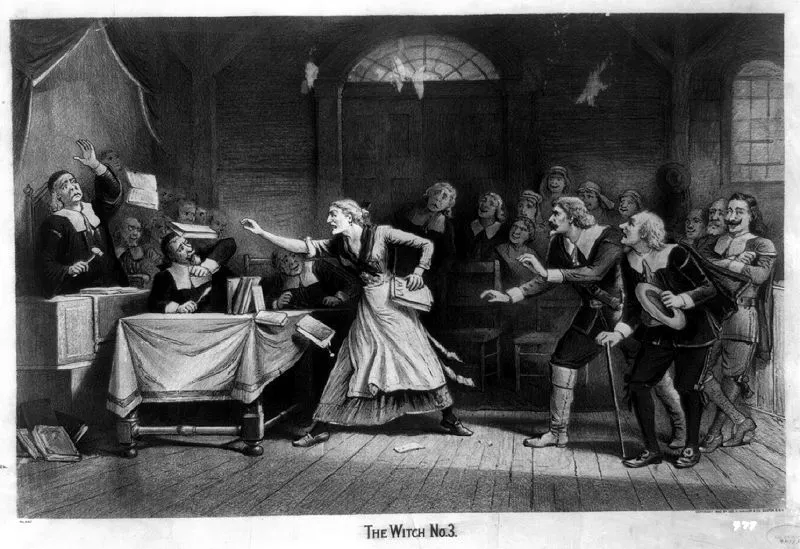
Colledge’s story ends in uncertainty. The record doesn’t tell us how long Sibbey was confined, what violence followed, or whether she ever recovered. But the stories of people who lose their pregnancies today do not have to end in criminalization. Ending these modern-day witch trials demands repealing laws that criminalize the aftermath of pregnancy, rejecting prenatal personhood as a tool for prosecutors, and affirming that pregnancy loss should never be recast as a nefarious and criminal act.
Follow Autonomy News on Instagram, Bluesky, TikTok, and LinkedIn.