The following is an excerpt from the new book Killers of Roe: My Investigation Into the Mysterious Death of Abortion Rights. Amy Littlefield, the abortion access correspondent for The Nation, set out to understand the motives, means, and opportunities behind the anti-abortion movement's victory.
It was Election Day 2024 and I was trafficking an unborn child across North Texas. That is, I was driving from Dallas to Amarillo while five weeks pregnant, an act that the chinstrap-bearded anti-abortion activist Mark Lee Dickson would deem “abortion trafficking of an unborn child”—if I was on my way to an abortion clinic.
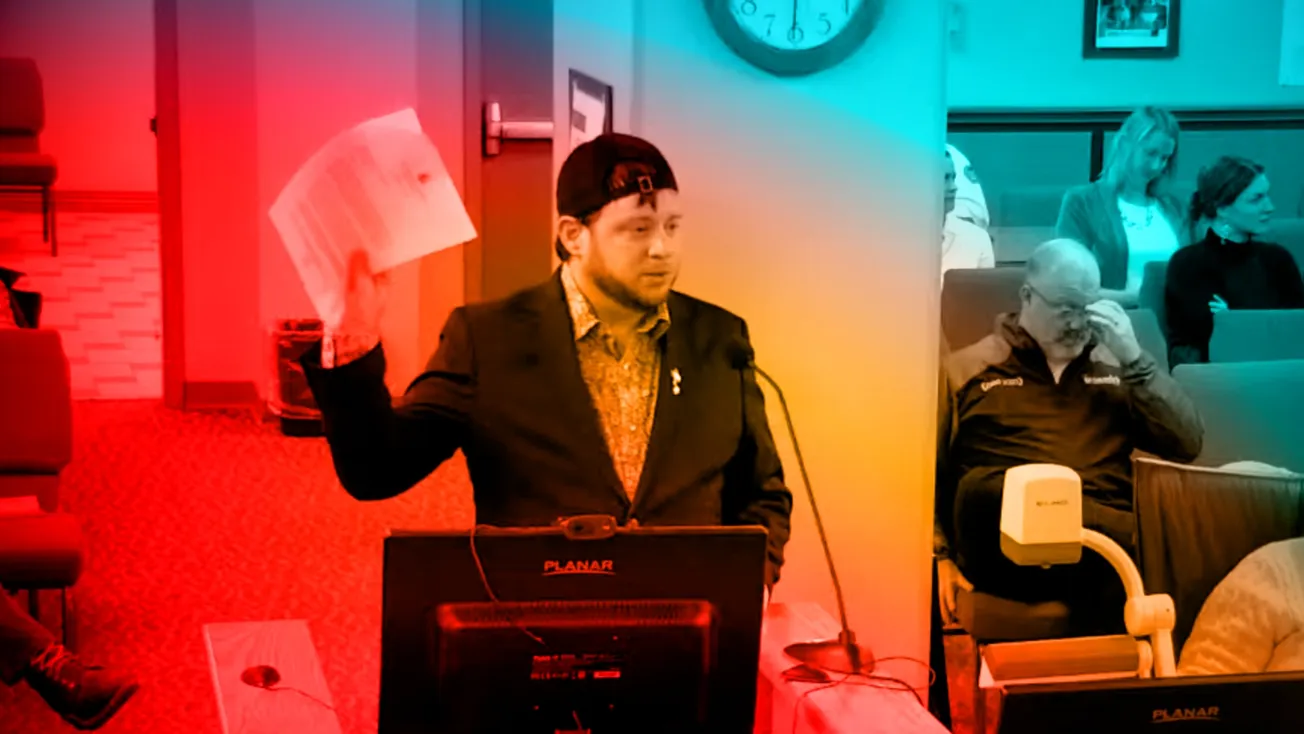
Instead, I was on my way to a polling place in the Texas panhandle to meet Dickson, the Johnny Appleseed of the anti-abortion movement, a 40-year-old virgin who had spent the past five years traveling through Texas and beyond in a button-down shirt, black backward baseball cap, and sneakers, sowing the poison fruits of anti-abortion innovation. His “Sanctuary City for the Unborn” ordinances proved the legal framework that was used to ban abortion at about six weeks across Texas in 2021. The Supreme Court allowed the ban to take effect in what turned out to be a preview of the murder of Roe v. Wade.
Not only did Dickson help kill Roe, but the ban he helped pass, Senate Bill 8, was implicated in the death of a woman in Texas, ProPublica had reported just days earlier. I was setting out to investigate the latest round of deaths caused by anti-abortion policies. Women in states that had banned abortion were dying, sometimes while suffering miscarriages of wanted pregnancies.
Meanwhile, Dickson was trying to address a major vulnerability of abortion bans to emerge since Dobbs—the fact that women knew how to drive. More than 35,000 Texans managed to leave the state to get an abortion in 2023, the first full year after the state banned abortion outright. Many of these abortion travelers drove through the panhandle, the part of the state that jutted up like a middle finger. Many thousands more went online and ordered abortion drugs from online pharmacies or from telehealth services like Aid Access—because sadly for Dickson, people who need abortions know how to use the internet.
Even worse for him, the Biden administration was allowing the shipment of abortion medication by mail, and Democratic-led states had passed laws to protect providers who sent these medications to states like Texas. Medication abortion was now the most common form of abortion nationwide, and logistically, it was easier to get than ever, even in states where abortion was banned—although, thanks to Dickson and his allies, accessing it could pose legal risks. In the year after fourteen states banned abortion outright, the number of abortions recorded nationwide increased. The bans weren’t working. Of course, sometimes they worked all too well, and women died.
I had made a decision I would soon regret: to spend Election Day with Mark Lee Dickson, in part to better understand this zealous and lonely man.
I had been trying to wrap my head around the human nature of Mark Lee Dickson for years, interviewing him as he traveled through airports or crisscrossed the country in his pickup truck, stopping at stores to buy a new button-down for his next city council meeting. He seemed to have little social life. He spent his days and nights on the road, alone, showing up in places where he was warmly welcomed by like-minded believers but sometimes loathed by residents and officials who saw him as a self-interested carpetbagger. His ordinances turned municipal councils accustomed to discussing the finer points of wastewater management into crowded squabbles over freedom and sin. His critics described him in colorful terms: “a dork,” “a loser,” “dangerous,” a “goofy bastard,” and a “nasty little gremlin man.”
His critics described him in colorful terms: “a dork,” “a loser,” “dangerous,” a “goofy bastard,” and a “nasty little gremlin man.”
Yet I found Dickson affable. He seemed to appreciate my coverage in The Nation because I was accurate, even when I described him in unflattering terms—like the time I quoted him comparing himself to the nineteenth-century anti-vice crusader Anthony Comstock and boasting that the moniker made him sound “like Batman.” He always picked up when I called.
But I’d seen another, more aggressive side of Dickson, too, in records of his correspondence with local politicians, which the legal organization Democracy Forward shared with me. His early writings, however, revealed that he was harshest on himself.
Mark Lee Dickson grew up in the Northeast Texas city of White Oak, on the outskirts of the larger city of Longview. His grandfather Glenn Canfield Jr. was a metallurgist and fixture in local Republican politics who ran Right to Life of East Texas. As a child, Dickson was fascinated by Canfield’s displays of fetal models at the Gregg County Fair. He marveled at how he himself was once the size of the dolls.

As he grew into his teenage years, his online writing revealed a self-flagellating religious devotion. “I must tell you the dangers of being a lustful minded sinner,” he wrote in a blog post around 2003. “With my very own mind I have committed adultery with almost every appealing actress that has been on television.”
These normal adolescent longings were a terrible sin to Dickson, who was steeped in Southern Baptist fire and brimstone and channeling the eighteenth-century preacher Jonathan Edwards’s sermon “Sinners in the Hands of an Angry God.”
“This I am very ashamed of, for I myself have been a sex-crazed teenager desiring that which is not to be tasted until the joining between a man and a woman in marriage,” he wrote. “This is such a hideous sin to admit.”
Dickson condemned homosexuality. “Even if you claim to be a Christian homosexual you spit on God’s word by ignoring the very truths that God clearly taught on the matter,” he wrote. Throughout the post, he excoriated himself. “Because of my sins, I deserve death,” he wrote. “I deserve to burn in Hell for eternity.
“I would almost question if we actually should cut our very own eyes out from our skulls to avoid committing adultery.”
As he grew older, Dickson seemed to avoid not just adultery, but all intimacy. “I’m twenty-seven years old and I’ve never cuddled with a girl,” he wrote on Facebook in June 2013. “The only things I have cuddled with thus far in life have been stuffed animals and BBQ, but I am completely OK with that. I just wish the BBQ cuddled back.”
By then, Dickson had begun to describe himself as the pastor of Sovereign Love Church, and had channeled his fascination with superheroes into starting a comic book club. People who attended the club told me it was a haven for nerdy, outcast kids who lounged on couches, socializing with one another and the spiny-tailed lizard named Papias Rex that Dickson kept in a terrarium. Ironically, given Dickson’s view that homosexuality was a sin, the club attracted queer kids like Savannah Bronson, who shared with me a series of alternately goofy and earnest Facebook messages she and Dickson exchanged in 2012, when she was 18 and he was 26, up late working shifts as a hotel security guard.
To me, these earnest late-night exchanges with someone eight years younger than him—alongside Dickson’s long-standing fascination with superheroes—spoke to something fundamentally childlike about Dickson. He often quoted Batman in our interviews. Once I interviewed him over lunch at a café in DC and he ordered grilled cheese and didn’t eat the crusts. Bronson told me she would later come to feel uncomfortable with these messages because of their age difference and Dickson’s position of authority running the comic book club. In one message, Dickson confessed to making missteps while pastoring the church.
“Is SovereignLove still up and running?” Bronson typed early one morning as Dickson stood guard over a hotel lobby.
“After about six months of pastoring the church start, I made some mistakes,” Dickson typed back. “I ended up buying alcohol for some people who were underage, lost an insane amount of funding … but did not believe that it was worth giving up on because of a few stupid mistakes that I made.”
“I’ve spent over 20,000 of my own money in the past two years on that building, so it hasn’t been easy,” he added.
Today, Sovereign Love is at the center of questions about where Dickson gets the money for his activism. Texas Monthly found that the church has paid well over $100,000 in legal fees to Dickson’s attorney, Jonathan Mitchell. Yet the church building appears abandoned. In photos taken by a visitor in 2024, moldering leaves lay alongside Jesus pamphlets on the floor. A toddler-sized action figure stood on a wooden desk. Nearby, stacked in front of a collection box and an enormous pillar candle on a lime-green stand were cardboard cutouts of superheroes and of the blond actress Kaley Cuoco as Penny Hofstader from the sitcom The Big Bang Theory. (Dickson told me the congregation still meets elsewhere.)
Some of the comic book club attendees struggled with mental health, as did Dickson. His anti-abortion beliefs, he told me, grew out of a link he saw between suicide and abortion. He seemed to identify with the unwanted fetus. He believed that all people deserved to feel wanted—a feeling he struggled to experience himself.
“Some nights the thought of dying is much more desirable than the thought of living,” he wrote on Facebook in June 2017, when he was 31. “As morbid as this may sound, it is the truth. I long for the day when I get to close my eyes and wake up to Jesus Christ.”
So Dickson set out to save the unborn who were unwanted.
In 2012, he began protesting outside a clinic in Shreveport, Louisiana. Sometimes he held a white plastic bullhorn and a sign that read “We will adopt your baby” on one side and “Babies are murdered here” on the other. Sometimes he could convince an “abortion-minded” woman from the clinic in Louisiana or one of the clinics he frequented in Texas to come with him to a 4D ultrasound facility where he asked the technician to record the sound of the fetal heart tones and implant it into two teddy bears: one for the woman; one for him.
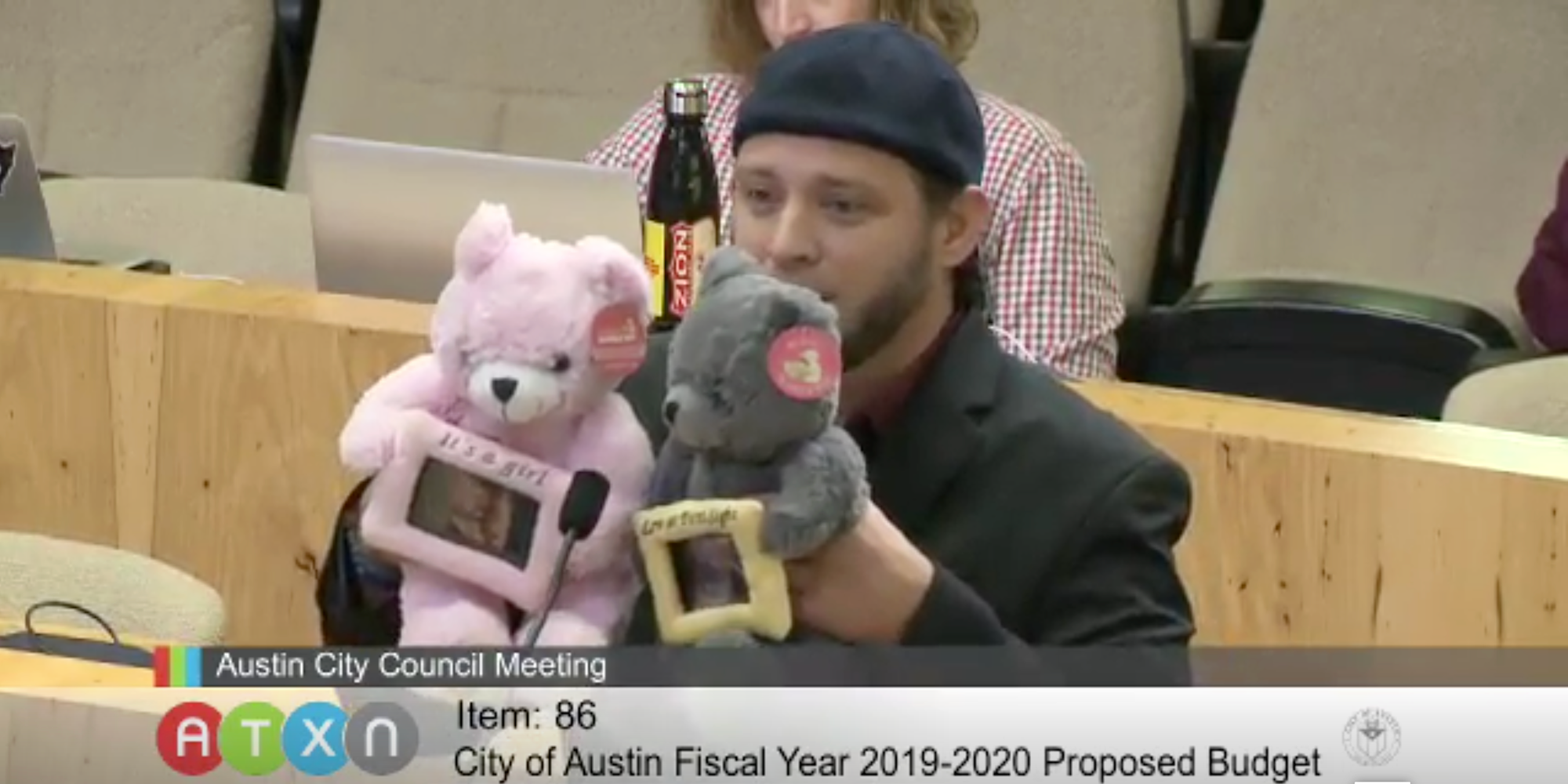
Perhaps there was a teddy bear sitting in the cab of his white Ford F-150 pickup truck on the day in 2019 when he and Jonathan Mitchell devised the first “Sanctuary City for the Unborn” ordinance. Dickson was at his favorite dining spot, Chick-fil-A. As he munched his French fries, he mulled the possibility that new restrictions on abortion in Louisiana might prompt the clinic in Shreveport to move to East Texas. Abortion was still a constitutional right. But Dickson wanted to find a way for towns to ban it anyway. So he called up Bryan Hughes, a Texas state senator who had been a pallbearer at his grandfather’s funeral.
On a three-way conference call, Hughes introduced Dickson, the eager ambassador, to Jonathan Mitchell, the legal mastermind. A graduate of University of Chicago Law School, Mitchell had clerked for the conservative Supreme Court Justice Antonin Scalia. His ideas about how to nullify the role of courts by resurrecting “zombie laws” from history books were so fringe that his former teacher called them dangerous and compared the idea to “a landmine.”
“Jonathan always puts the fear of God in me, because God forbid he should be right on this particular question,” Richard Epstein, the former teacher and a leading conservative legal scholar, told a Federalist Society panel in 2018.
Mitchell told Dickson he thought that cities could ban abortion and avoid having their bans declared unconstitutional if they outsourced enforcement of the bans to private citizens. It was a wild idea—but true believer that he was, Dickson was ready to sell it door-to-door. Mitchell wrote an ordinance to ban abortion in Waskom, Texas: population 1,900. When five white men on the Waskom city council raised their hands to pass the ordinance in June 2019, a few Texas abortion rights groups noticed but most people didn’t take the threat seriously.
“We did underestimate the power of a man in a backwards cap driving around in his car to spread the gospel about anti-abortion.”
“We did underestimate the power of a man in a backwards cap driving around in his car to spread the gospel about anti-abortion,” Drucilla Tigner, an attorney who worked for the Texas ACLU at the time, told me. “I think we soon learned that lesson.”
Dickson and his teddy bears were soon crisscrossing Texas. He always presented the same proposal: If a city passed the ordinance and agreed to participate in Jonathan Mitchell’s legal experiment, then Mitchell would represent the city for free if they got sued.
In 2020, Dickson pulled into the West Texas city of Lubbock. Lubbock, unlike many small towns Dickson visited, actually had an abortion clinic. Lubbock’s city council voted the proposal down. So he and his supporters put it on the ballot for voters to decide. By then, more people were paying attention. Planned Parenthood’s national office spent $430,000 to defend the clinic. Their supporters knocked on doors and made almost 200,000 phone calls. But in May 2021, residents of the city of Lubbock approved the ban. Pro-choice groups filed a lawsuit to defend the Planned Parenthood clinic, which gave Mitchell a chance to defend his unconventional theory in court. Just as he had hoped, a federal judge allowed the ordinance to stand. The clinic in Lubbock stopped performing abortions. In a corner of West Texas, access flickered out, the first sign that Roe itself was dying.
Meanwhile, state Senator Bryan Hughes, who for at least part of that year was living at home with his parents, had copied the private enforcement mechanism into Senate Bill 8. The law banned abortion when embryonic cardiac activity could be detected, around six weeks. On September 1, 2021, the Supreme Court let the ban take effect. Abortion clinics across Texas began turning away anyone whose embryo sounded like Dickson’s teddy bears.
After Dobbs, states including Texas banned abortion outright, and Dickson and Mitchell formulated a new experiment to make the bans work: They had begun to commune with ghosts. It was not the first time Dickson had encountered the undead. Over a decade before, he posted on a message board that as a child, he had “seen what many people would classify as ‘ghosts’ as well as ‘shadow people,’” including “a woman in my hallway” and “a witch-like woman who was floating above my window staring down at me.”
“The instance where I witnessed the witch-like woman I could not move at all,” he wrote. “If you would like to talk to me about your experiences feel free to shoot me a message.”
Finally, someone had answered. Jonathan Mitchell was about to help Dickson bring the anti-vice crusader Anthony Comstock back from the dead.
Anthony Comstock was a post office inspector and secretary of the New York Society for the Suppression of Vice whose crusade against obscenity would make him “one of the most important men in the lives of nineteenth-century women,” Amy Sohn wrote in her book on Comstock, The Man Who Hated Women. He had been raised on a farm in New Canaan, Connecticut, to revere the “Victorian ideal of womanhood—a saintly, pure wife and mother whose domain was the home.” It was an ideal embodied by his own mother whom, as a child, Comstock found dead in her bed after she had given birth to his younger sibling.
In one of sexual history’s most impactful psychological twists, Comstock channeled this trauma into a lifelong crusade to purge the country of prurient longings. He went to Washington, DC, where he staged a spectacular display of sex toys and parlayed his one-man crusade against immorality into the first federal obscenity law to link pornography with contraception. The 1873 Comstock Act made the distribution, sale, and mailing of obscene materials including contraception and abortion drugs and devices a crime. The federal law spawned a series of “little Comstock” laws in the states, including one in Comstock’s home state of Connecticut that criminalized anything that interfered with conception—even the withdrawal method.
Comstock terrorized Planned Parenthood’s founder Margaret Sanger and the well-to-do nineteenth-century abortion provider Madame Restell, who operated openly and ostentatiously in an era when abortion was illegal, yet common. When Restell died by suicide while awaiting trial after he orchestrated her arrest, Comstock bragged about it.
Today, this law would never get through Congress, but that was the point. Instead of passing a new law, Dickson and Mitchell would try to revive the section of the Comstock Act that made sending abortion pills and devices through the mail a federal crime punishable by up to five years in prison. While the optics of resurrecting a Victorian-era zealot who boasted of driving people to suicide weren’t ideal, the law’s appeal was obvious: It didn’t require democratic support from the American people, who broadly support abortion rights. Yet if the courts took it literally, as Mitchell did, it would operate as a de facto nationwide abortion ban, because it could prevent the shipment of all pills and supplies needed for abortion.
Killers of Roe: My Investigation Into the Mysterious Death of Abortion Rights is available wherever books are sold.
Follow Autonomy News on Instagram, Bluesky, TikTok, and LinkedIn.