
A Wednesday hearing in Georgia’s Gwinnett County was dominated by comments opposing additional public funding for Georgia Wellness Group, an anti-abortion crisis pregnancy center. It was a continuation of a controversy that began in July, when Atlanta-area reproductive justice advocates launched a campaign urging residents to tell the local Board of Commissioners to stop funding the center. Despite significant public opposition, the commissioners approved $450,000 in public funds for Georgia Wellness in August. Now, they will consider the organization’s new request for over $630,000 in fiscal year 2026.
“If this money was truly aimed at helping Gwinnett residents, it could fund real, life-saving services such as expanding community health centers for prenatal and postpartum care, funding home visit programs for new parents, using data to target neighborhoods where maternal health and infant health outcomes are the worst,” said Alicia Stallworth, director of Georgia campaigns for Reproductive Freedom for All, in the hearing.
Anti-abortion centers have long received federal funding, primarily from welfare programs like Temporary Assistance for Needy Families, and various iterations of abstinence-focused sex education and teen pregnancy prevention programs. Georgia Wellness, for example, has received more than $2 million from the Sexual Risk Avoidance Education Program since 2021.
However, county records obtained by Autonomy News via a public records request show that the commissioners of Gwinnett County have, since 2020, granted more than $1.1 million in federal funds to Georgia Wellness from an unusual source: the Department of Housing and Urban Development’s (HUD) Community Development Block Grant program (CDBG). Block grants are lump sums the federal government gives to states, cities, and counties, which then distribute awards to local organizations. In fact, the purchase of the organization’s current facility for over $2 million appears to have been paid for in part by a CDBG grant.
Multiple experts told Autonomy News this was the first they’d heard of crisis pregnancy centers accessing these federal housing funds, and Georgia Wellness’ CDBG funding largely escaped public notice until last year. The American Medical Association opposes all public funding for crisis pregnancy centers, having resolved that such money should “only support programs that provide complete, non-directive, medically accurate health information to support patients’ informed, voluntary decisions.”
Georgia state Rep. Marvin Lim, whose district includes parts of Gwinnett County, has been working for years to sound the alarm about what he says may be a deceptive and coercive organization. “I don't think they should have been receiving that funding … given what their mission and practices are,” he told Autonomy News. The five county commissioners did not respond to our request for comment by publication time.
Lim said he even alerted the Biden administration’s Gender Policy Council—a first-of-its kind division of the Executive Office of the President, which was tasked with, among other things, heading up federal efforts to protect reproductive healthcare in the wake of the Supreme Court overturning Roe v. Wade. The Gender Policy Council included every member of the president’s cabinet, including the HUD Secretary. Lim asked the Biden administration to issue guidance to prevent crisis pregnancy centers from accessing HUD funds, but nothing came of his request.
This summer, advocates and state lawmakers made public comments in opposition to further funding for the center, citing medical disinformation in service of a religious agenda. A former medical director even alleged that the center “misled” patients about its ability to provide medical care. And despite its touting of medical services on grant applications and its own website, it’s unclear who the facility’s current medical director is. Autonomy News has also learned that at least one medical staff member’s license is the subject of a complaint to the Georgia Composite Medical Board. Several people who publicly criticized Georgia Wellness were served cease and desist letters alleging defamation.
Despite many of these issues surfacing at public meetings, the Gwinnett County Board of Commissioners voted 3-2 to approve $450,000 in CDBG funds for Georgia Wellness on August 5, in addition to the nearly $750,000 it had received since 2020. Commissioner Jasper Watkins III, a Democrat whose district includes Georgia Wellness, defended the center. Fellow Democrat and board Chairwoman Nicole Love Hendrickson did, too, and cited concerns that the county could lose federal funds if it denied an application on ideological grounds.
Georgia Wellness’ 2025 grant funds are intended for a maternal mental health program, pediatric care, and—perhaps most alarming to reproductive justice advocates—a maternity home.
Proposed maternity home raises fears of coercion
According to a review of public records, last year appears to be the first time Georgia Wellness asked for CDBG funds for an explicitly housing-related expense—its maternity home. Previous grant applications were centered on medical offerings like pregnancy confirmation, testing and treatment for sexually transmitted infections, and prenatal care. It might sound odd that a federal housing program would pay for these types of services, but CDBG grants don’t just directly fund housing: they can be used for a variety of community programs benefiting low- and moderate-income people. According to its grant application, the Georgia Wellness maternity home “will be a residential facility equipped to accommodate up to 6 pregnant women aged 18 and older and their babies until 18 months after birth.” The center’s website says that “residential housing” is “coming soon.”
Local advocates and experts raised alarms at two Gwinnett County Board of Commissioners meetings in July and August—not because of the stated purpose of the money, but because of the organization asking for it. Crisis pregnancy centers exist to persuade people to continue their pregnancies and don’t provide or refer for abortions. Their well-documented tactics include misleading pregnant people; endangering their health by promoting misinformation and overselling their ability to provide medical services; and requiring clients to “earn” support by doing things like attending Bible study or “family values” classes.
Crisis pregnancy centers are typically religiously affiliated, and most are associated in some way with national anti-abortion organizations. However, they often hide their religious and ideological leanings from prospective clients. While Georgia Wellness is clear on its website that it does not provide or refer for abortions, the site doesn’t mention any religious leanings. But according to a strategic plan submitted with its 2025 CDBG application, its number one value is “Truthful, meaning, we base all truth on God’s Word and evidence-based medical information.” The center’s CDBG-funded mental and behavioral health program will also be operated in partnership with a church. As Autonomy News has previously reported, crisis pregnancy centers often struggle to recruit qualified physicians. Georgia Wellness acknowledges this problem in its plan, which identifies among a list of weaknesses, “inability to provide more OBGYN services without a physician willing to provide services,” and “bad reviews from angry patients” and “lack of adequate/involved physician” as potential threats to the organization.
‘If this money was truly aimed at helping Gwinnett residents, it could fund real, life-saving services’
Georgia Wellness did not respond to a detailed list of questions sent prior to publication. However, in a July press release, the organization said, “Georgia Wellness provides routine and high-risk prenatal care (the only provider in Gwinnett County offering both at no or low cost), STI testing and treatment, gynecological services, maternal mental and behavioral health care, and post-pregnancy support.”
Maternity homes are not new, but anti-abortion organizations have framed them as a major part of their post-Dobbs strategy—and many are linked to crisis pregnancy centers. The landmark Turnaway Study, which compared people who got a wanted abortion with those denied care, found that most people who wanted an abortion cited multiple reasons. However, financial stressors were among the most common, and those who were denied abortions were more likely to live in poverty. This means that, with abortion bans forcing more people to give birth, more families will need financial support, including housing aid.
The strategy may also be, in part, a matter of optics: “Maternity homes are a key response to the questions: ‘What about that child?’ ‘What about that mother?’ ‘What are you doing to help them?’” reads the website of Heartbeat International, a major crisis pregnancy center umbrella organization which also runs the Maternity Housing Coalition. According to a 2024 Maternity Housing Coalition report, there are just under 500 maternity homes in the U.S.
Advocates told Autonomy News they worry that a crisis pregnancy center-affiliated maternity home might employ coercive or manipulative tactics on vulnerable people at risk of homelessness. For example, several maternity homes across the country have recently been accused of coercing residents into relinquishing their children for adoption, in a disturbing callback to the pre-Roe “Baby Scoop Era.”
“What are the stipulations that people are going to have to abide by to be able to receive this housing?” asked Allison Glass, state campaign director at the reproductive justice advocacy organization Amplify Georgia, which led a public campaign to oppose the funding. “We know that maternity homes are steeped in a history of coercion, and control, and racism,” Glass said. “Of course people need housing, but it should not come with that type of risk.”
Former medical director alleges false advertising; substandard care
In recent decades, crisis pregnancy centers have increasingly offered limited medical services in an effort to counter the accusation that they are “fake clinics.” Starting in roughly 2017, Georgia Wellness—then called Pregnancy Resource Center of Gwinnett—became affiliated with Obria Medical Clinics, a medicalized crisis pregnancy center network. Obria presents itself as a provider of “comprehensive” reproductive healthcare, and was explicit from the start about its mission to become an anti-abortion alternative to Planned Parenthood. Some Obria centers even received Title X family planning funds during the first Trump administration.
Georgia Wellness’s 2025 CDBG applications tout a history of providing prenatal care, claiming to have “served 627 prenatal patients and delivered 335 healthy babies” since 2021, and to have provided mental health services to 23 women since 2023.
But one former staff member has accused Georgia Wellness of false advertising when it comes to medical services. The allegations came to light in an unexpected way: After Amplify Georgia initiated a text message campaign urging community members to oppose funding for the center, its former medical director, Dr. Marc Jean-Gilles, responded. He gave Glass permission to share his lengthy message with the Gwinnett County commissioners at the August meeting.
'Patients essentially are told to go through emergency services and hope they can be scheduled'
Jean-Gilles, who left the organization in June 2024, alleged that, despite advertising prenatal care, Georgia Wellness was not affiliated as of summer 2025 with any physicians who have hospital admitting privileges. Instead, he said, staff advises patients to “go through emergency services” when they go into labor or face any complications. “Why would a clinic falsely advertise the ability to provide obstetrical care when they can’t provide a doctor who can deliver their babies??? Why are we rewarding bad unethical behavior!” he wrote. “Pregnant women deserve better.”
Jean-Gilles also claimed that, at the time he spoke with Amplify Georgia, the post of medical director was being filled by a retired doctor. According to Jean-Gilles, that medical director was Dr. Gary Walker, who is listed in Georgia Wellness’ 2025 CDBG application materials as a retired OBGYN and board member. Walker “could come out of retirement to deliver babies, but he won’t,” Jean-Gilles wrote. According to the Georgia Composite Medical Board license verification portal, Walker’s physician license expired on November 30, 2019. A new “Volunteer in Medicine” license, a special type of license for retired doctors, was issued to Walker on October 15, 2025—meaning he was without a license for nearly six years, including during the time period that Jean-Gilles claims he was the medical director.
Jean-Gilles didn’t respond to our request for comment. Autonomy News was unable to verify Jean-Gilles’ claims, or determine who served as medical director during this time period and who occupies the position today.
According to the most recent grant applications Autonomy News was able to obtain, a different retired doctor was the part-time medical director of Georgia Wellness as of July 2024: Dr. Mike Mojcik, who retired from his medical practice in 2021 but maintains an active medical license. (Georgia Wellness also lists a Dr. Max Jean-Gilles—who appears to be Dr. Marc Jean-Gilles’ father—as a part-time OBGYN on these applications.)
Per the medical board license verification portal, both Mojcik and Walker maintain admitting privileges at a hospital referred to as “Emory Eastside.” But that hospital, now called Piedmont Eastside Medical Center, hasn’t been part of the Emory system for more than 15 years. Autonomy News was unable to reach Mojcik or Walker for comment. Georgia Wellness did not respond to our questions about their employment or admitting privileges. We also contacted Piedmont Healthcare, Emory Healthcare, and GCMB for comment but did not hear back by publication time.
‘Why are we rewarding bad unethical behavior! Pregnant women deserve better.’
A typical doctor’s office would have information about its providers on its website. Georgia Wellness does not. So Andrea Swartzendruber, a professor of epidemiology and biostatistics at University of Georgia and an expert on crisis pregnancy centers, looked up every staff member she could identify based on the center’s applications and other public statements. She discovered yet another irregularity.
In some states, nurse practitioners can be fully independent. But in many others, including Georgia, they must be supervised by a licensed physician. A nurse practitioner named Cynthia McClendon is named on several Georgia Wellness grant applications and has worked at the center since 2017, according to her LinkedIn. Swartzendruber discovered that, according to the state medical board, McClendon’s “delegating physician” for her work at Georgia Wellness since April 2018 was Walker—the retired OBGYN. According to a document available on the medical board website, this arrangement—known as a nurse protocol—was listed as active as of July 2025, even though Walker’s physician license had been expired since late 2019 and his volunteer license wouldn’t be issued for several more months. The document also lists Georgia Wellness’ old address. According to Georgia law, any changes to nurse protocols must be submitted to the medical board for review within 30 days.
Swartzendruber submitted an open records request to the medical board regarding McClendon’s nurse protocol in August 2025. By October—the same month Walker received his new volunteer license—the protocol was mysteriously listed as “terminated.” Swartzendruber said Georgia Wellness “may have put clients at risk through lack of appropriate licensure,” but that she also considers the medical board to be “highly culpable.” A source who asked Autonomy News not to name them said they submitted a complaint about the matter to the Georgia Composite Medical Board in late 2025. GCMB did not respond to a request for comment, and complaints are not public record.
According to the American Medical Association, “any entity licensed to provide medical or health services to pregnant people” should “ensure that care is provided by appropriately qualified, licensed personnel.” Neither the GCMB, Georgia Wellness, nor McClendon responded to requests for comment.
Glass said these findings are particularly disturbing given that Georgia Wellness advertises prenatal care in a state that has among the highest rates of pregnancy-related death in the nation. “We cannot afford to be … giving people care in such an irresponsible way,” she said.
In defending Georgia Wellness against criticism last summer, its executive director Robin Mauck emphasized the qualifications of her staff. “Just because we don't provide an abortion doesn't make us a fake clinic. All of our doctors are licensed; they’re credentialed,” she told WSB-TV Atlanta. “We are a real clinic. We have board-certified, licensed physicians and medical staff,” she said to Atlanta News First. In a press release, Georgia Wellness said its clinic “operates under the license and supervision of a Board-Certified OB/GYN Medical Director.” However, the release does not name any medical director. As for board certification, Mojcik is currently board-certified, but Walker is not, per the American Board of Obstetrics and Gynecology.
In her comments at yesterday’s public meeting, Mauck invited detractors of Georgia Wellness to “come tour our facility, and see what we really do.”
Advocates hit with cease and desist letters for “defamation”
However, Georgia Wellness seems intent on silencing critics. At the August county commissioners’ meeting, the organization’s lawyers served Glass and one of her Amplify Georgia colleagues with cease and desist letters. Reproductive Freedom for All’s Alicia Stallworth said during yesterday's meeting that she received one as well. “Almost every advocate that spoke out at the first public comment period received one,” said Glass, referring to the July meeting.
Swartzendruber received a letter, too. Like Glass, Georgia Wellness accused her of defamation, specifically by calling the organization a crisis pregnancy center. Swartzendruber is a leading researcher on the subject: She and her colleague Danielle Lambert lead the team that created and maintains the Crisis Pregnancy Center Map, a national, geolocated directory of crisis pregnancy centers. They have published several studies based on this work in peer-reviewed journals. (And, yes, Georgia Wellness appears in their listings.) Swartzendruber was further accused of defaming Georgia Wellness by saying it fails to meet medical practice standards. The letter she received claims that “all medical services provided by Georgia Wellness are provided by credentialed medical professionals.”
Surprisingly, the letter to Glass also asserted she defamed Georgia Wellness by saying it is affiliated with Obria, the national chain. According to the letter, “Georgia Wellness is an independent, locally operated clinic no longer affiliated with Obria on an organizational, legal, or operational level.” However, any observer could be forgiven for not knowing that. As of publication time, the website obriagwinnett.org was still live, featuring Georgia Wellness’ current phone number. The organization’s 2025 CDBG applications—submitted in July 2024—still use the name Obria throughout. In fact, in an organizational chart submitted with that application, “Obria” appears as an entire division of Georgia Wellness, encompassing all OBGYN services.
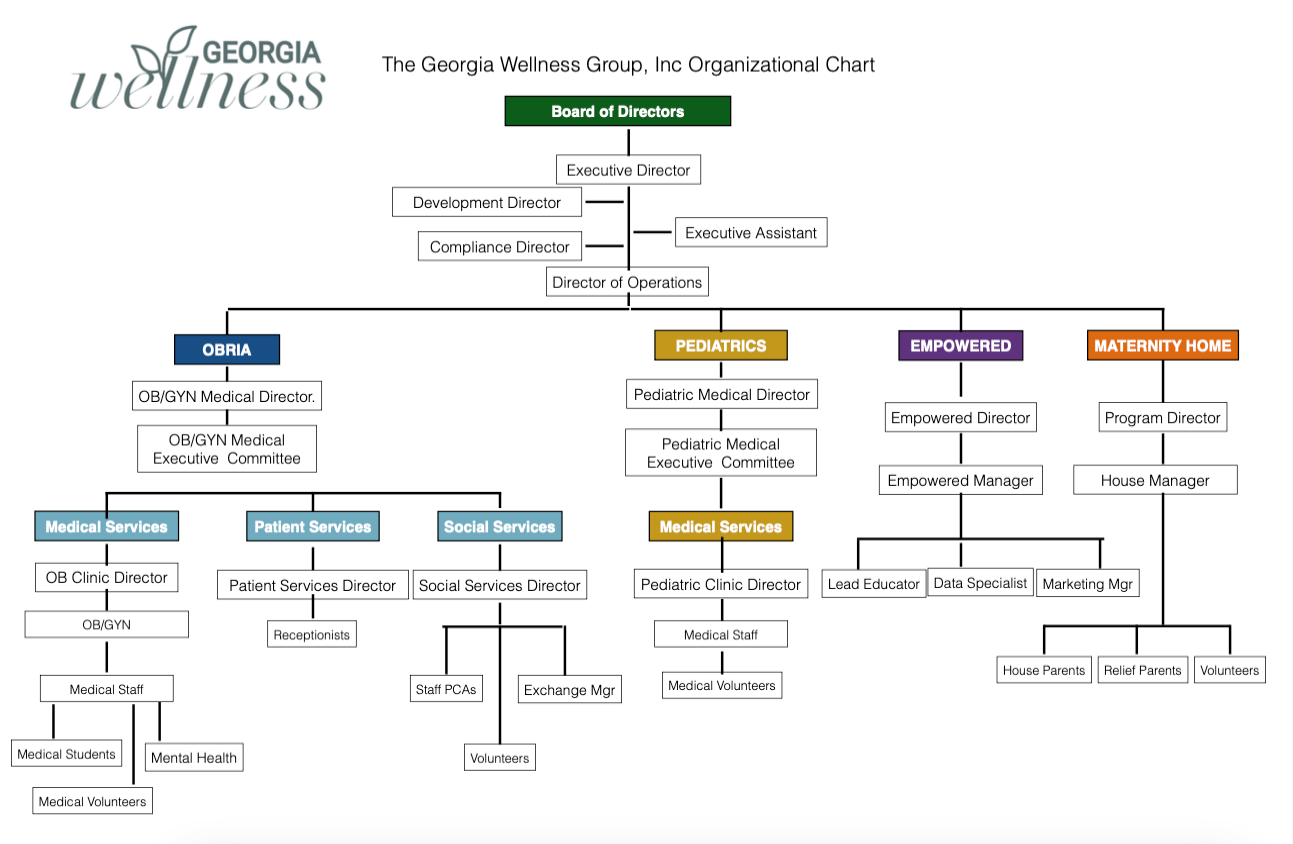
In August 2024, Obria’s former CEO, Dawn Hughes, went public with allegations that Obria manipulates patients and inflates the number of people it serves. Its founding CEO, Kathleen Eaton Bravo, came under fire in 2019—during the time Georgia Wellness was doing business under the Obria name—for making overtly white supremacist comments. It’s not clear when Georgia Wellness ended its affiliation with Obria, whether the decision was related to Hughes’s whistleblower turn, or how the change might have affected service provision at Georgia Wellness. The most recent post on a Facebook fundraising page called “Friends of Obria Gwinnett” is from March 2025.
Georgia Wellness did not respond to questions about disaffiliating with Obria.
In response to the cease and desist letter, an attorney for Amplify Georgia pointed out that the organization and its employees have a right to speak up during a legislative session about matters of public concern, and that the opinions they expressed were informed by facts—including Georgia Wellness’ well-documented association with Obria.
Biden administration inaction
Georgia Wellness also slapped three state lawmakers with cease and desist letters based on comments they made on social media. One of them, Rep. Lim, has been working to oppose public funding of the center for years. Lim first became aware of Georgia Wellness in 2021, when the center invited legislators to an event, presenting itself as a resource for prenatal care. “I sit in a maternity healthcare, or perinatal care desert to begin with, one which has higher rates of maternal mortality” than the state average, Lim said. “So I was really excited.”
But Lim always vets a resource before recommending it to his constituents, and he was familiar with the deception of crisis pregnancy centers because of his prior work as an attorney with the American Civil Liberties Union of Georgia. He quickly realized that Georgia Wellness—then operating as Obria Medical Clinics—was a crisis pregnancy center. Then, in 2022, around the time of the Dobbs decision, Lim was looking into which organizations in his district had received expanded CDBG funds that were part of the Coronavirus Aid, Relief, and Economic Security (CARES) Act. He spotted Georgia Wellness on the list.
Lim reached out to the county commissioners to alert them that Georgia Wellness was a crisis pregnancy center. All of the commissioners at that time were Democrats, but in speaking with one of them, “I heard, ‘Well, this is going for facilities and not for care.’ So they were fine with that,” Lim said. “What that has opened the door to, though, is other facilities, like a maternity home.”
At that time, Lim was also in touch with the White House Gender Policy Council, a contact he established following the 2021 Atlanta spa shootings where a gunman killed eight people, including six Asian women. In July 2023, Lim sent an email directly to Jennifer Klein, who was then head of the Gender Policy Council and an assistant to President Joe Biden. He outlined the CDBG funding Georgia Wellness had received to date, attaching documentation, and asked the administration to issue guidance prohibiting crisis pregnancy centers from accessing any Housing and Urban Development funds, including CDBG—which would have been well within the agency’s power.
“Thanks so much for this note,” Klein wrote back about 30 minutes later. “I will follow up, and we will get back to you.” Lim says he did hear from someone in Klein’s office once more, but only to say they were still looking into it.
'I was disappointed in the administration that they didn't take further action'
At the time, the Biden administration was already under pressure to cut off government funds to CPCs. In October 2023, the administration proposed a rule that would have made it more difficult for states to give crisis pregnancy centers funds from the Temporary Assistance for Needy Families program—but not any other federal programs. Republicans introduced legislation in 2024 intended to undercut the rule, and the Biden administration withdrew it on January 14, 2025, days before Donald Trump resumed office.
“I engaged some national organizations as well, and it was really hard for us to figure out if this was happening elsewhere,” Lim told Autonomy News. “I was disappointed in the administration that they didn't take further action, and I don't even think looked into, ‘well, is this happening elsewhere?’” Through a spokesperson, Klein declined to comment beyond saying that her agency had asked HUD to investigate the matter.
It wasn’t just the White House that showed an apparent lack of urgency on the issue, Lim said. During last summer’s local funding debate, “There were nonprofits whom I really respect, and are doing great work, that sent clients to Georgia Wellness Group, that stood up for Georgia Wellness Group, because it was their view … [that] they have provided care where there was none,” he said. “The question is, to me, why are we accepting this as the standard of care?”
The public comment period for 2026 CDBG applications remains open until February 9. After that, commissioners will decide whether to advance Georgia Wellness’s request for over $630,000 in new CDBG funds.
This story was edited by Susan Rinkunas and copy edited and fact checked by Hannah McAlilly.
Follow Autonomy News on Instagram, Bluesky, TikTok, and LinkedIn.