Since 2023, six states have enacted laws requiring public schools to show their students a three-minute video created by the anti-abortion group Live Action, or something similar. The “Meet Baby Olivia” video, which purports to show the phases of embryonic and fetal development, has been lambasted by experts for its scientific inaccuracies and ideological bent.
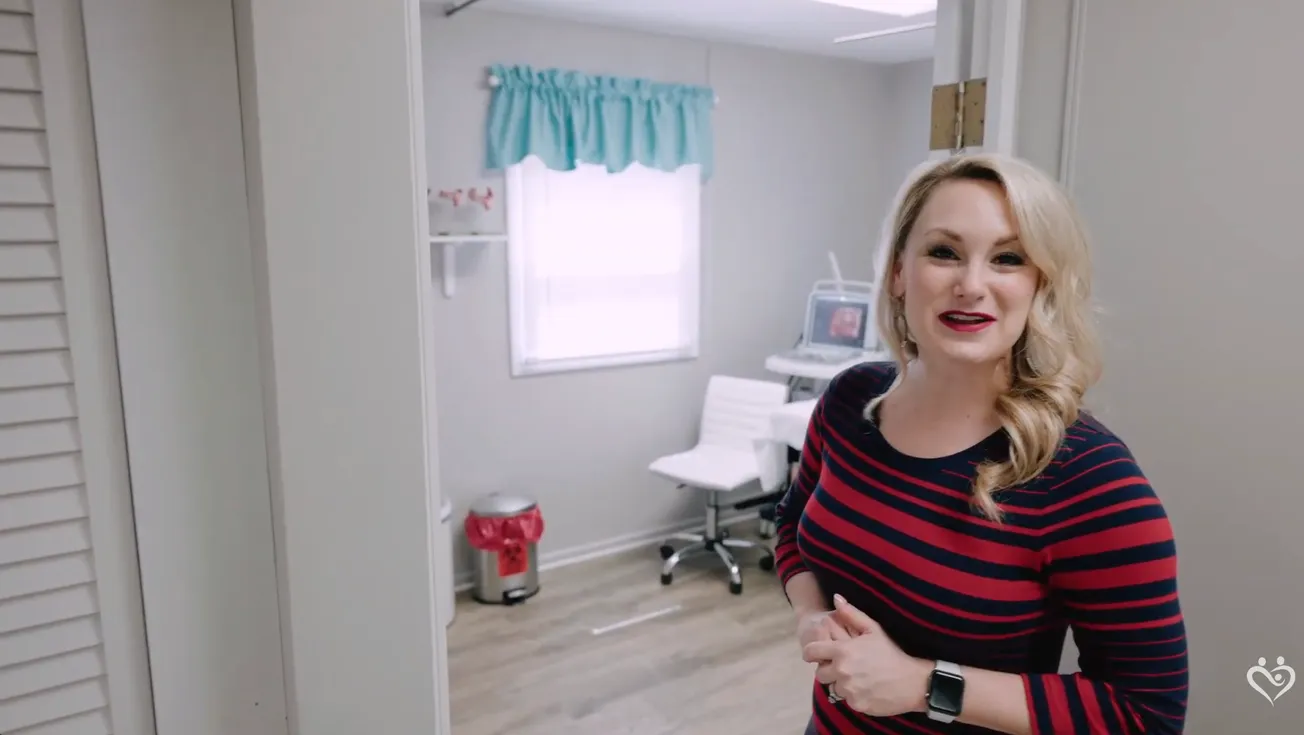
Similar legislation has been introduced in more than 20 states, and Ohio could be the next to make it law. A version of the Baby Olivia Act passed in the Ohio House last month, and the Senate will likely pick it up when its session resumes in late January. But there’s something that stands out about Ohio’s Baby Olivia Act: Its lead sponsor, Rep. Melanie Miller, is the executive director of a crisis pregnancy center.
For anyone aware of crisis pregnancy centers and their tactics, showing a manipulative video to a captive audience will be a familiar move. CPCs are anti-abortion facilities that mislead and delay people seeking abortions. They trade in disinformation about pregnancy, sexual health, and abortion. Many even promote unproven and potentially dangerous interventions like abortion pill “reversal.”
To the extent CPCs provide support for people continuing pregnancies, it usually comes with strings attached. For example, many centers—including Miller’s CPC, Ashland Pregnancy Care Center—provide goods like diapers, wipes, and formula. However, in order to get them, clients must first earn “Baby Bucks” or “Mommy Money” by doing things like attending “family values” classes or going to Bible study. Some crisis pregnancy centers even force people to watch anti-abortion videos while waiting for pregnancy test results, or while leading them to believe they are in a legitimate abortion clinic.
What the Baby Olivia video gets wrong
While the medical and scientific communities generally don’t consider pregnancy to begin until a fertilized egg has implanted in the wall of the uterus, the Baby Olivia video advances the anti-abortion movement’s view: that pregnancy, and life itself, begin at fertilization. “This is the moment that life begins,” says a British narrator, immediately after an animation that shows sperm fertilizing an egg. “A new human being has come into existence. At fertilization, her gender, ethnicity, hair color, eye color, and countless traits are already determined.”
Though it doesn’t mention the Baby Olivia video by name, the American College of Obstetricians and Gynecologists (AGOC) has criticized these bills. “Across the country, legislators are passing bills that would force students in public schools to watch videos that promote a particular political agenda as part of their sexual education curricula,” reads a statement on the organization’s website. “These videos use emotionally charged language and medically inaccurate information to manipulate how children understand pregnancy. “
The video intentionally dates pregnancy by counting the number of weeks since fertilization, rather than from the first day of a pregnant person’s last menstrual period, said David Hackney, a maternal-fetal medicine specialist, professor of reproductive biology at Case Western Reserve University, and former chair of ACOG’s Ohio section. Dating from the start of the last menstrual period is admittedly “archaic and somewhat idiosyncratic,” Hackney said. Still, it’s the medical standard.
By contrast, dating from fertilization—which happens roughly two weeks later—allows the Baby Olivia video to make misleading claims about fetal development. One such claim: “Around 20 weeks, with a lot of help, babies have survived outside the womb”—referring to what is actually 22 weeks’ gestational age. While some infants can survive after being born this early, it is rare, and they usually live with significant complications. “It’s a little bit of sleight of hand,” Hackney said, adding that the video’s claim reinforces the incorrect idea that fetal viability is a line that can be easily drawn.
“The other thing they do is they ascribe consciousness to neurological function, when it’s unclear there is consciousness,” Hackney said. For example, the video claims that fetuses “play” in the womb by week 11, and have mature taste buds by week 12. (Remember, that’s week 13 and 14 in common parlance.) “It may be accurate to say that the fetus has taste buds by a certain developmental stage, but to translate that to ‘the fetus can taste’ is much more complicated,” he said. Like much anti-abortion legislation, he added, the video describes cardiac activity as a “heartbeat” at gestational stages where that term isn’t yet accurate. “So much of the current debate is a semantic war,” he said.
“So much of the current debate is a semantic war.”
“Meet Baby Olivia” also looks like it takes place on a pink cloud rather than inside a human body. Notably, “it discusses no changes in the pregnant person's body, how pregnancy may impact them, or the risks of pregnancy,” said Miranda Estes, state policy and action manager at SIECUS: Sex Ed for Social Change. In a state like Ohio where sex education is not required to be comprehensive or medically accurate, she added, young students may not even understand enough about sex and anatomy to contextualize the information in the video even if it were accurate.
This information war is in service of a specific goal: banning all abortions, and changing public opinion, which is staunchly in favor of abortion rights. Live Action calls abortion “the greatest human rights crisis of our time,” and says its vision is a “world where every human life is protected by both love and law from conception to natural death.”
“In this post-Roe era, banning abortion didn't accomplish what anti-abortion groups wanted it to accomplish, which was limiting the number of abortions,” said Jamie Miracle, deputy director of the Ohio reproductive rights advocacy organization Abortion Forward, noting that the abortion rate actually rose after Roe v. Wade was overturned. In fact, the most recent data shows that it continues to rise. “Now they're just turning to scare tactics, to stigma, to propaganda, to force their message in public schools, via advertising, via all of these things that the state is funding,” she said.
Bringing CPC tactics into public schools
In many ways, the Baby Olivia Act brings CPC tactics into classrooms. Perhaps it’s no surprise, then, that the lawmaker who introduced the Ohio bill is the executive director of a CPC in her district. “What the bill is accomplishing is pushing the same propaganda that is pushed in [Miller’s] center, and centers across Ohio, and across the nation, as mandatory pieces of the public school curriculum in Ohio,” Miracle said. “We know that this misinformation and propaganda leads to the stigma around abortion.”
However, while the bill inspired extensive local media coverage, Autonomy News could only find three news stories that mentioned Miller’s association with a CPC. Notably, two of the three are from independent, nonprofit outlets, and all date back to the bill’s introduction. Miller’s day job escaped notice in most stories from major news outlets, including many stories about the House passage of the bill, and a longer TV spot featuring an interview with Miller.
Miller’s job isn’t a secret. It’s on her campaign website, mentioned in her biography on the Ohio House of Representatives site, and included in her annual ethics disclosures. About two months before introducing the Baby Olivia Act, Miller attended the fourth-annual Live Action Lawmakers Summit in Coeur d’Alene, Idaho. “Crisis pregnancy center director introduces anti-abortion model legislation” is a ready-made headline—so why was this fact only a footnote?
Support paywall-free, worker-owned journalism! Make a tax-deductible contribution to our end-of-year campaign now.
Miller didn’t lean on her professional role in promoting the bill, either. In her floor speech urging colleagues to vote in favor of it, she made no mention of her work at Ashland Pregnancy Care Center. Smiling widely in a canary yellow suit, the former Miss Ohio did, however, read a Bible verse that is a favorite of the anti-abortion movement: “For you created my inward parts; you knit me together in my mother’s womb. I praise you, because I am fearfully and wonderfully made.”
She also made misleading claims about fetal development and used the term “baby” to describe the fetus. “Colleagues, this is biology,” she said, later falsely stating the bill “promotes scientific literacy.” Unlike most others, Miller’s version of the Baby Olivia Act also requires that students are shown “a high-definition ultrasound video … showing the development of the brain, heart, sex organs, and other vital organs in early fetal development” in addition to Baby Olivia, or a similar video. (In the Ohio Senate, a different version of the bill has been introduced, which does not mention Baby Olivia by name. That bill, as well as Miller’s version, are awaiting committee review.)
In the House Education Committee, Miller’s bill was modified so that it will be shown to students starting in fifth grade, rather than third grade. This is still an earlier age than many of the other Baby Olivia bills, according to Estes, who can’t help but see irony in the original bill’s requirements. “When SEICUS wants to run healthy relationships education for third graders … we get called ‘groomers,’” she said.
"When [we want] to run healthy relationships education for third graders … we get called ‘groomers.'"
Sex education in Ohio is already deeply lacking, said Bethany Lewis, executive director of Preterm, a Cleveland, Ohio, clinic that provides abortion as well as other sexual and reproductive healthcare. Reproductive health education is a “core value” at Preterm, Lewis said, and the organization often tables at community health fairs and other events to provide resources and education. “It's really shocking what people don't know about their own bodies,” she said, adding that there’s a “history of misinformation or no information around sexual and reproductive health” in Ohio schools.
“Baby Olivia is going to make this problem so much worse,” she said.
Are Miller’s actions ethical?
Lewis also believes that CPCs, including Miller’s, stand to benefit from the legislation. Baby Olivia could “really prime young Ohioans to adopt very harmful beliefs about reproductive health, their own bodies, and about abortion, and that will make them even more susceptible to crisis pregnancy centers,” she said.
Ohio has the fifth-highest number of CPCs of any state in the country, Estes said, despite being 7th in population. The state also gives millions in government funds to these centers every year. However, according to Ashland Pregnancy Care Center’s Form 990 financial disclosures, it has not received public funds since 2021—though the most recent 990 available is from 2023. No recent state payments to Ashland Pregnancy Care Center appear in a public records database, either. And the Baby Olivia Act doesn’t directly funnel money to CPCs. But what if it earns them more clients? Would that be a conflict of interest for Miller?
“It is not a conflict of interest in a strict sense,” said Richard Briffault, a professor at Columbia Law School and an expert on government ethics. “In most states, legislators are allowed—or expected—to actually have outside businesses. They're not paid as if it's a full-time job.”
That makes the question of conflicts of interest “tricky,” he said. “You can have farmers in the legislature who also get to oppose and vote on bills dealing with agriculture, and presumably lawyers in the legislature who get to oppose and vote on bills dealing with personal injury litigation.”
Given Miller’s job, and the legislation’s “ideological overtones,” said Briffault, “presumably this is a matter of personal belief … I’m not sure I’d call it a conflict of interest. It’s just her interest.”
"I’m not sure I’d call it a conflict of interest. It’s just her interest."
According to the Ohio Legislature’s Code of Ethics, lawmakers “may” request permission to abstain from voting on legislation in which they have a “substantial personal interest.” There are only a few situations in which they are required to abstain, including when they are an employee or “business associate” of an organization advocating for legislation. In other words, if Ashland Pregnancy Care Center had been lobbying for the Baby Olivia Act, Miller would have needed to abstain from voting on it. Autonomy News didn’t find any evidence of the organization promoting the bill.
Miller isn’t the first CPC director to serve in the Ohio state legislature, Miracle, of Abortion Forward, said. Former Rep. Candice Keller, who served from 2016 to 2020, was also a CPC director. She was one of the lead sponsors on a 2019 bill that would have criminalized abortion as murder and required doctors to attempt to “reimplant” ectopic pregnancies, which is impossible. Keller did face criticism over a potential conflict of interest that same year, when she sponsored a bill to give tax credits to people who donate to CPCs.
As for Miller, her actions don’t run afoul of official ethics rules, and they align with her personal values. Maybe that’s why her role as a CPC director escaped attention in so much media coverage. She’s a conservative Republican, so people expect her to support anti-abortion legislation. But should they?
Not all of Miller’s constituents oppose abortion rights. Her district includes all of Ashland County, and some of Medina County. In 2023, when Ohioans decisively voted to adopt constitutional protections for abortion rights until fetal viability, Ashland was one of the counties where the measure failed to earn majority support. But not by much: 42 percent still voted “yes.”
In Medina County, the reproductive rights measure passed with over 55 percent of the vote.
This is despite the fact that both counties went for Trump by a wide margin in 2024, and Miller ran for re-election that year unopposed. Clearly, these are conservative districts. But as we’ve seen in many states, “conservative” doesn’t actually mean “anti-abortion” to the extent that most political coverage would lead us to believe.
Autonomy News reached out to Miller’s office to give her an opportunity to respond to critiques of the medical and scientific accuracy of the Baby Olivia video, her own statements about fetal development, and allegations that the bill could send more clients to her nonprofit. She did not respond by publication time.
This story was edited by Susan Rinkunas and copy edited and fact checked by Hannah McAlilly.
Follow Autonomy News on Instagram, Bluesky, TikTok, and LinkedIn.