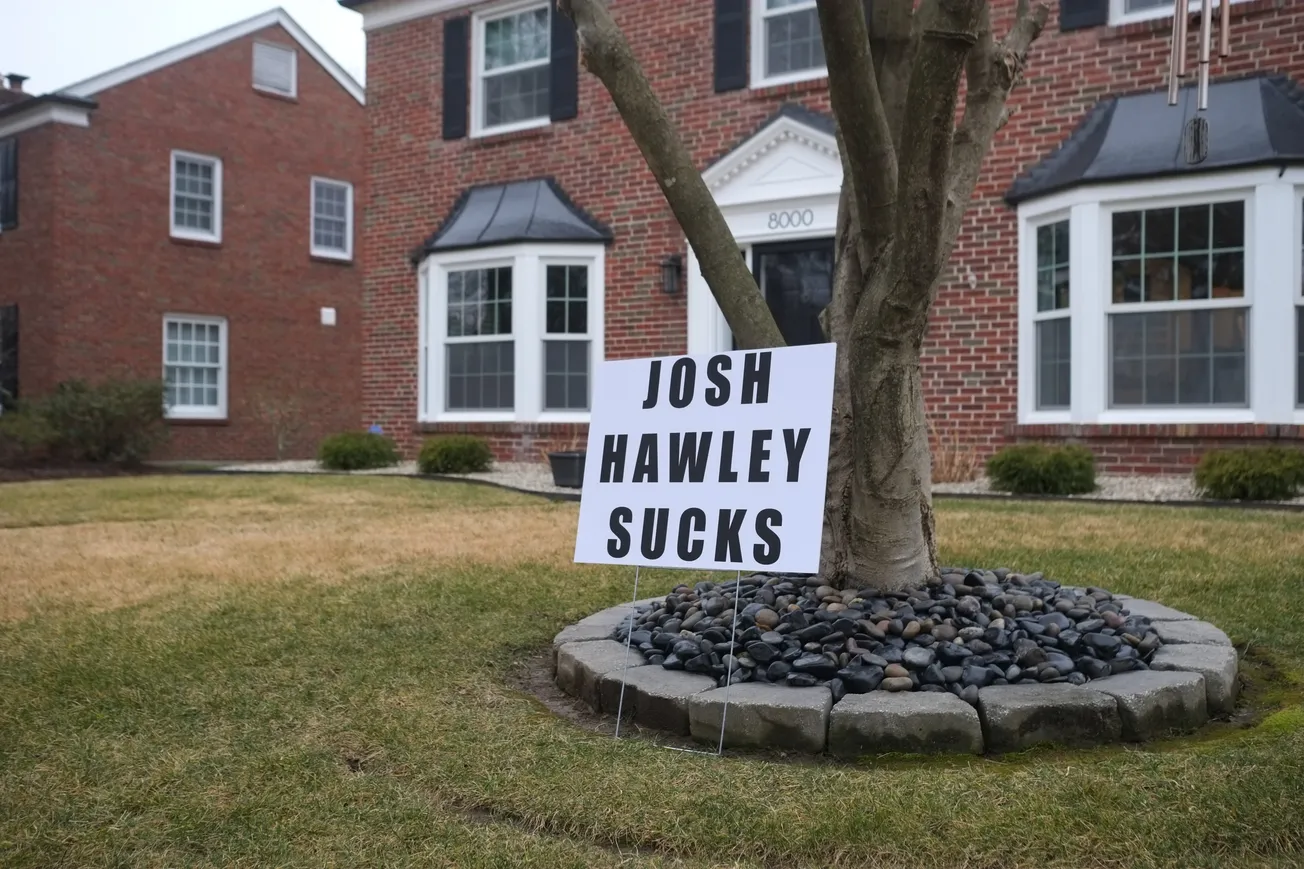
In a recent press conference marking the introduction of his bill that would strip the medication mifepristone of its Food and Drug Administration approval for pregnancy termination, Missouri Sen. Josh Hawley claimed that mifepristone is “inherently dangerous to women and prone to abuse.” Two weeks later, Louisiana Sen. Bill Cassidy made a similar comment when announcing an investigation into mifepristone manufacturers, asserting that online availability of the medication opens “the door for coercion and abuse.”
These similar statements were no coincidence: Lawmakers and activists alike have increasingly coalesced around this narrative in their all-out assault on medication abortion, claiming specifically that improved access—especially via telehealth—has led to reproductive coercion in the form of widespread forced abortions. Reproductive coercion is a real problem, and there are some documented cases of men charged with giving their partners abortion pills without their knowledge or consent. However, the anti-abortion movement is seizing on these events to advance the manufactured narrative that abortion pills are inherently dangerous and in need of more regulation, either at the hands of the FDA or federal courts.
Some of the stories referenced in recent federal lawsuits are also dubious. For example, in August, Autonomy News reported on a lawsuit filed by former Texas Solicitor General and “bounty hunter” abortion ban architect Jonathan Mitchell on behalf of a woman who said her male partner put abortion pills in her hot chocolate and caused her to have a miscarriage. The man quickly countersued, alleging not only that the story was made up, but that it was engineered to help pass additional abortion pill restrictions in the state. Lawmakers referenced Mitchell’s suit in legislative hearings for a bill that eventually became HB 7, which was enacted late last year and allows people to sue those who manufacture, provide, or distribute abortion pills to or within Texas, for bounties of at least $100,000.
Abortion providers, on the other hand, say they more often see a different type of reproductive coercion: people forced to become or remain pregnant against their wishes.
“Reproductive coercion happens, and it is, quite frankly, usually at the hands of anti-abortion partners, extremists, and bans,” said Brittany Fonteno, president and CEO of the National Abortion Federation (NAF), a professional organization for abortion providers. Mitchell would know a thing or two about this—one of his most high-profile clients, a man who sued a doctor in an attempt to prevent his girlfriend from getting an abortion, is a convicted abuser.
How telemedicine abortion can prevent coercion
In addition to offering medical guidelines for abortion care, security support, and other assistance for providers, NAF operates the National Abortion Hotline, the largest national abortion support service. The hotline connects callers with trusted providers of abortion care, as well as with resources like financial support. According to recent patient testimonials shared with Autonomy News, many NAF hotline callers say abortion has been their lifeline to escape abuse. And in cases of intimate partner or family violence, telehealth can provide a more discreet and accessible way to seek care.
“I need to do this as discreetly as possible,” wrote a 26-year-old from Mississippi. “I’m in a relationship that I’m trying to safely get out of and I can’t be pregnant while I do it. I can’t have a baby with him. I can’t have another baby, period.”
“My husband raped me when I asked for a divorce and impregnated me in an attempt to get me to stay,” wrote a 25-year-old in Texas. “He doesn’t know and he can’t know or I can’t divorce him. He is financially controlling so I don’t have a lot of money at this time. Thank you.”
A 29-year-old in South Carolina wrote that she “just left a domestic violence situation with the father of all the kids.” Three weeks after her abusive partner was incarcerated, she found out she was pregnant. “I was a stay-at-home mom for 7 years and have literally just started getting all the bills caught up and figuring out life,” she said. “I have no idea how to even afford this right now but I cannot have another. I have extremely difficult pregnancies and end up hospitalized almost every time and don’t have a support system to help.”
A 31-year-old also from Texas said that she had just left an abusive relationship she was “stuck” in for three years. “He forced three pregnancies on me as of now,” she said, explaining that she already had two children under two years old, and was pregnant again. “My body has not healed. I have not healed and I will not have another baby by this man,” she wrote. “He is an abuser and I will not let him have control over me or my body any longer. He physically abused me while I carried the previous two.”
The claim that women are often manipulated or forced into having abortions isn’t new—it dates back at least to the nineteenth century, when this assertion appeared often in the writings of Dr. Horatio Storer, a leader of the “physician’s crusade” that resulted in the first U.S. abortion bans. Likewise, reproductive coercion—including forced birth as well as forced sterilizations, abortions, and medical experiments on marginalized people—has a long history in the U.S., Fonteno of NAF noted, stretching from the time of colonization and chattel slavery all the way to the present day.
“The loss of power and control is really something that unnerves anti-abortion extremists.”
But now, telehealth allows people a greater degree of autonomy by giving them new ways to access abortion care, Fonteno said. “That's exactly why there are these increased attacks, and this sort of myth creation” around the safety of medication abortion, she added. “The loss of power and control is really something that unnerves anti-abortion extremists.”
This is especially true thanks to “shield” law providers, who practice in states where abortion is legal and prescribe pills to patients in ban states. (While shield law providers are NAF members, the organization only provides funding for care they provide within their own states, Fonteno said.)
‘No bots in abortion’
NAF’s hotline plays a key role in helping callers exercise this autonomy by allowing them to connect with trained, human case management staff in a world increasingly dominated by chatbots. But the union that represents hotline staff is concerned that its members could lose their jobs to artificial intelligence—and that callers could lose access to a human-to-human connection. According to the National Abortion Hotline Union, NAF won’t commit to negotiating with the union before replacing workers with AI tools. The union went public with these fears in a late February Instagram post, and has urged the public to send letters about the issue to NAF management as contract negotiations continue.
“NAF management refuses to commit to not replacing our members with artificial intelligence,” the union wrote. “We ask that they agree to bargain over the implementation and effects prior to the introduction of new technologies that would replace our exceptional and dedicated staff.”
Asked about the union’s public statements, Fonteno told Autonomy News that NAF is “not planning to replace staff members with AI, but we're looking to leverage AI for efficiencies, to help people in their day-to-day work.”
However, a representative told Autonomy News on behalf of the union that NAF management has resisted “codifying this protection into our union contract,” and that management repeatedly rejected proposals “that would guarantee a person would be involved in care with all our clients.” (Union members didn’t want to be identified individually for fear of retaliation.) At this point, the representative said, the union is only asking that management bargain with them before implementing any use of AI that would result in union members being laid off.
“Any use of AI for ‘efficiencies’ that did not result in a reduction of staff would not be impacted by this current proposal,” the representative said. “If there is no intention to lay off workers, why can’t they make a commitment to bargaining with us before replacing our team?”
There is also a long history of violence and intimidation against abortion providers and patients in the U.S., and security threats are on the rise in the wake of President Trump’s pardons of 23 anti-abortion extremists. Potential risks include digital attacks, and providers look to NAF as a key resource for security services. When asked what protections the organization has in place to ensure the digital security of staff and clinicians, as well as the privacy of clients if and when any AI technologies are used, Fonteno said that NAF doesn’t yet have a policy because it is a “newer area” for the organization. “We have a cross-functional task force with representation from across the whole organization coming together to co-create a policy around using AI at NAF,” she said.
Two union members were invited to participate in the task force, but the representative said that “our experience so far is that it is focused on training staff to use AI in our work contexts, while not questioning or discussing the ethics of its use.” While the union is “grateful” to be involved, the representative added, its members believe substituting humans with AI would present an inherent security risk. “We do not feel that this task force is a sufficient replacement for protections within the collective bargaining agreement,” they said.
"We hear from callers every day that they are grateful to reach a human, that we are the first person or the only person they have felt safe to talk to."
“Our position as a unit is that we do not think it is right for abortion providers and seekers to have to interface with AI in the place of speaking with a knowledgeable and supportive team member,” the representative continued. “We hear from callers every day that they are grateful to reach a human, that we are the first person or the only person they have felt safe to talk to. All of our team understands the enormity of that.”
Fonteno declined to comment further on contract negotiations, “out of respect for our staff and the integrity of the process.” However, “my commitment, and our commitment as an organization,” she said, “really remains in protecting access to abortion care by ensuring long-term strength and sustainability of the hotline.”
It’s not the first time NAF has responded to criticism from abortion allies by saying it is operating with the hotline’s long-term future in mind, but this time that critique is coming from its own workers.
This story was edited by Susan Rinkunas and copy edited and fact checked by Hannah McAlilly.
Follow Autonomy News on Instagram, Bluesky, TikTok, and LinkedIn.