Table of Contents
Welcome to the latest edition of our weekly roundup. Every Monday, we’ll send you a summary of the biggest stories about bodily autonomy. We’ll also include links to pieces that Garnet or Susan have published.
If you’d prefer to receive a single email every week, you can do that—we love autonomy. You can manage your subscriptions by navigating to the site, clicking on “Account” in the upper right, then under “Emails,” select “Manage.” You can toggle off “Autonomy News” to receive only the roundup, or vice versa.
Let’s dive in.
On Autonomy News
2025 is coming to a close, and we are so excited to continue building Autonomy News in 2026. But we need your help to make our work sustainable.
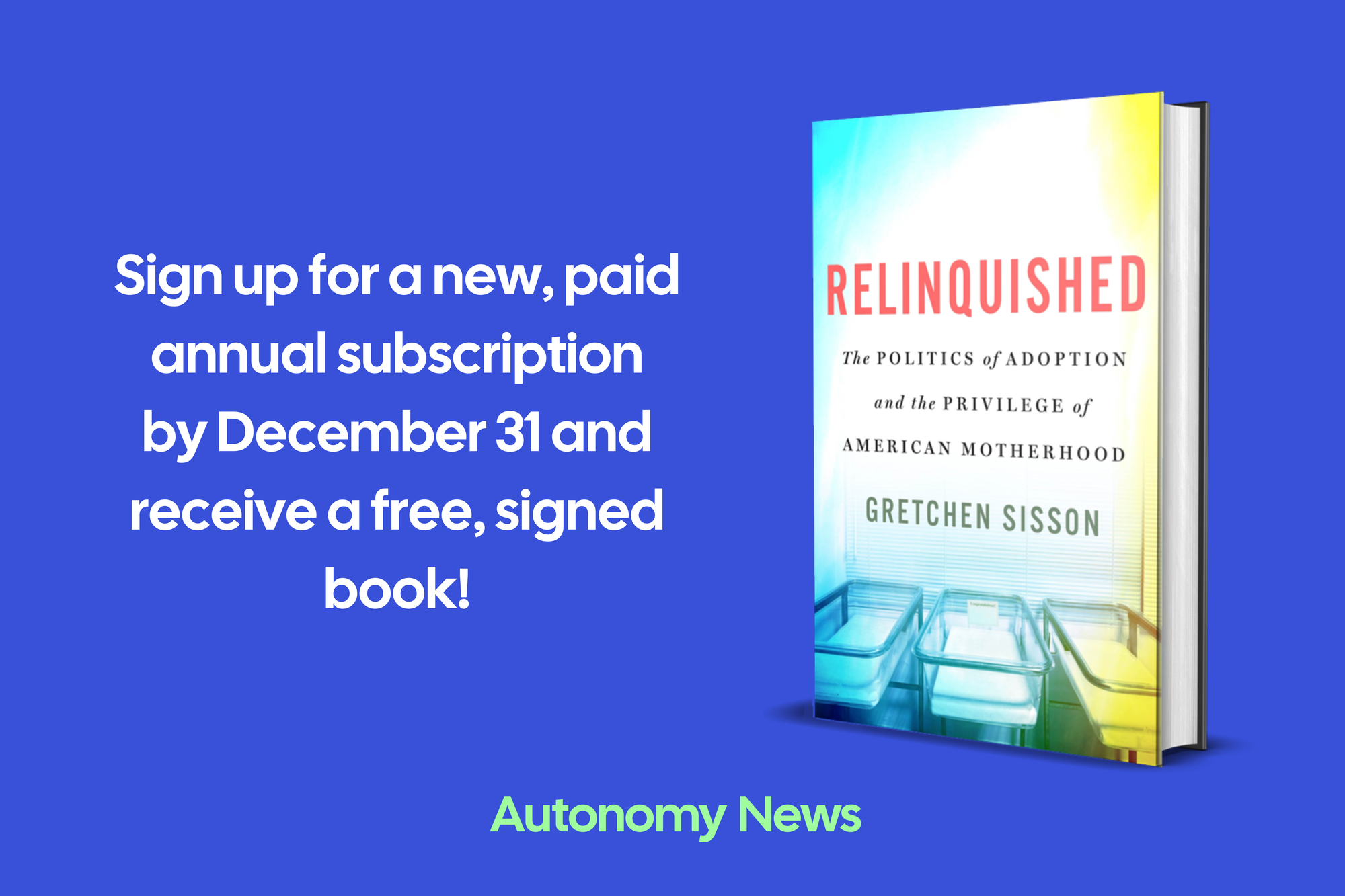
In case you missed it, we have a fun perk: Sign up for a new, paid annual subscription before December 31 and you will receive a free, signed copy of researcher and Autonomy News subscriber Gretchen Sission’s book Relinquished: The Politics of Adoption and the Privilege of American Motherhood. (If you would like your book sent to an address other than your billing address, please email us at autonomynewsco@gmail.com.)
If you prefer to make a tax-deductible contribution, support our end-of-year campaign today! We are deeply grateful to our paid subscribers, but most of the revenue that will support our work in 2026 has come from larger gifts and grants. You can donate online, or give from a donor-advised fund or by check—instructions here.
Federal news
The First Circuit Court of Appeals has again ruled against Planned Parenthood, permanently overturning a lower court ruling that would have blocked enforcement of the Congressional budget law provision “defunding” large abortion providers. Medicaid already doesn’t cover abortions in most cases, so this provision was intended to block insurance reimbursements for services like birth control and STI testing. The First Circuit had already paused the lower court’s injunctions, so this ruling was largely expected. However, the three Biden-appointed justices said their decision was based on the fact that Planned Parenthood is “unlikely to succeed on the merits” of its challenge—meaning unlikely to win in the end.
In a separate lawsuit over the “defund,” brought by 22 states and Washington, D.C., the First Circuit also sided with the Department of Health and Human Services, blocking a similar order that would have prevented HHS from withholding Medicaid payments to Planned Parenthood while litigation proceeds. Both cases will continue in the Massachusetts court of District Judge Indira Talwani, but in the meantime, Planned Parenthood and other affected abortion providers are still shut out of Medicaid except in states that have stepped up with stopgap funding.
Bloomberg reports that the Food and Drug Administration is dragging its feet on a promised “review” of the safety of the abortion drug mifepristone—because Commissioner Marty Makary reportedly told agency workers to put it off until after the midterm elections. Predictably, major anti-abortion groups, including Susan B. Anthony Pro-Life America, are furious. SBA is now calling on the Trump administration to fire Makary.
In somewhat related news, the Attorneys General of Florida and Texas have sued the FDA, arguing that its original approval of mifepristone in September 2000 under an accelerated process was unlawful and should be reversed. This is mostly a re-filing of the same complaint that the states initially put before Judge Matthew Kacsmaryk in their attempt to join a suit brought by the AGs of Missouri, Kansas, and Idaho. But Kacsmaryk denied their request, and transferred the underlying case to Missouri. This time, Florida and Texas filed in a different division of the same federal district, one in which they were guaranteed to draw ultraconservative Judge Reed O’Connor. Unsurprisingly, their lawsuit cites the junk science analysis from the far-right Ethics and Public Policy Center to argue that mifepristone is less safe than the FDA says it is. It also argues that the FDA’s two approvals of generic versions of mifepristone, in 2019 and September of this year, were unlawful.
There are two other abortion pill-related suits against the FDA right now: The aforementioned Missouri case and one filed by Louisiana, though both those cases are focused on ending telemedicine prescriptions and do not ask to revoke the drug’s approval. However, all three suits argue that the FDA decision allowing abortion pills to be mailed violates the Comstock Act of 1873, a federal anti-obscenity statute that conservatives are weaponizing to try to ban shipments of the pills nationwide. These cases are now on an eventual collision course with the Supreme Court.
Anti-abortion group Students for Life of America is urging supporters to request that the Environmental Protection Agency add mifepristone to a list of drinking water contaminants that public utilities track. There’s an upcoming public comment period to update the list of water contaminants, which the EPA does every five years, and the idea to use the comment process came out of a meeting between agency staff and Students for Life in November. The organization is also relying on graphic language to support its efforts, with head of policy Kristi Hamrick telling Politico: “People need to understand that they are likely drinking other people’s abortions. Do you really need a test to determine that it’s a bad idea to flush placenta, tissue, blood and human remains into our waterways?” We are drinking abortions in the same way we are drinking other people’s feces, Kristi. The group knows its effort is a long shot, but still views it as part of turning public opinion against medication abortion.
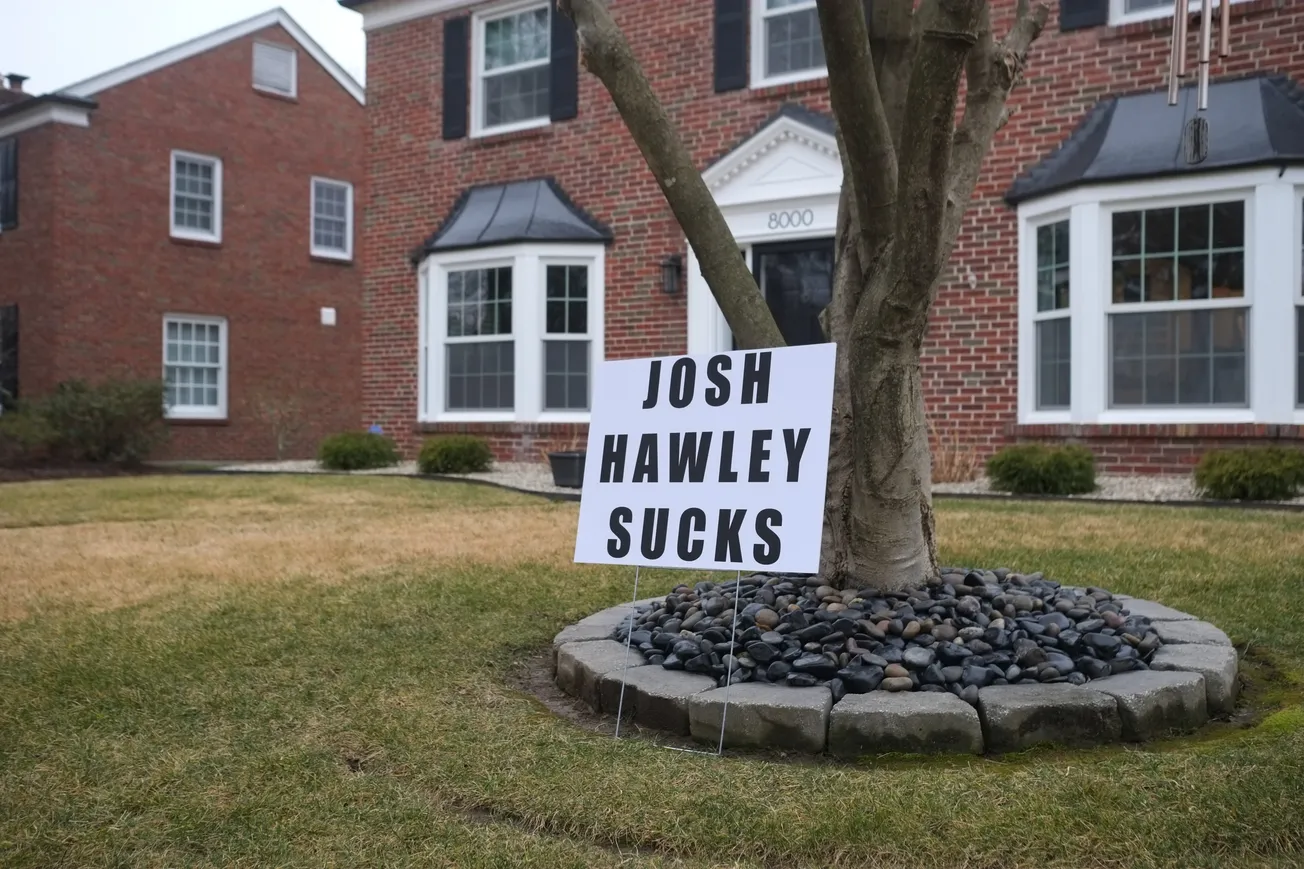
Missouri Sen. Josh Hawley is launching an anti-abortion dark money group to support conservative constitutional amendments. He is starting the Love Life Initiative with his wife, Erin Hawley, an attorney for Alliance Defending Freedom, the Christian nationalist law firm that helped get Roe v. Wade overturned. (Erin is representing Louisiana in the above lawsuit against the FDA.) The Hawleys plan to support a 2026 Missouri ballot measure that would ban abortion after voters enshrined the right in 2024, and say they intend to get involved in other states as well. Sen. Hawley told Axios that "elected officials have been more and more reluctant to comment, to weigh in, to frankly, do much on the issue of life." For what it’s worth, Trumpworld is pissed and worried that more talk of abortion bans will hurt the GOP in the midterms.
Immigration and Customs Enforcement is using specialized smartwatches to track pregnant people, including during labor. Confusion and fear surrounding the devices is interfering with hospitals’ ability to care for their patients, healthcare workers told the Guardian.
State news
New York Governor Kathy Hochul is reportedly poised to veto two reproductive health-related bills. One would strengthen protections for electronic health data—like information collected by period trackers and other apps and websites—making it illegal to share such data without a user’s express consent. The other would require hospitals to be more transparent about whether they provide abortion and gender-affirming care. Tech and healthcare companies have lobbied hard against the bills, and NYC for Abortion Rights is urging people to call Hochul’s office to demand she sign them. Hochul already vetoed a birth control access bill this year, which would have required insurers to reimburse pharmacists for their time spent counseling patients when dispensing birth control without a prior prescription, which they have been allowed to do since 2023. An update to New York’s shield law intended to better protect providers of abortion and gender-affirming care is also still awaiting Hochul’s signature.
Louisiana Gov. Jeff Landry named anti-abortion OBGYN and vaccine skeptic Dr. Evelyn Griffin as the state’s new surgeon general. Health Secretary Robert F. Kennedy Jr. chose Griffin to serve on the Centers for Disease Control and Prevention’s vaccine advisory panel, where she recently voted to end the decades-long policy of recommending the Hepatitis B vaccine for all infants at birth.
The attorney general of South Dakota sent a cease-and-desist letter to a group that shares information about how to get abortion pills. The nonprofit Mayday Health was set to begin a gas station advertising campaign last week with ads that read: “Pregnant? Don’t want to be?” and include the url for Mayday’s website, which in turn features links to online abortion pill providers. AG Marty Jackley accused Mayday of “deceptive advertising of the sale of abortion pills,” but the organization said in a statement that the campaign is First Amendment-protected free speech. “Mayday is an education nonprofit. We don’t sell abortion pills, we just believe people should know their options.” Mayday ran similar campaigns in Kentucky and West Virginia. Previously, Arkansas AG Tim Griffin threatened to sue Mayday and another information site, Plan C, for simply hosting webpages with information for Arkansas.
The sponsor of Wisconsin’s anti-abortion pill bill has removed the strange and unnecessary requirement that providers send medication abortion patients home with a “catch kit” to collect embryonic or fetal remains. However, the bill—which is based on the aforementioned Students for Life conspiracy theory that abortion pills pollute our water supply—is still in play, focused mostly on penalties for drug manufacturers.
Florida Governor Ron DeSantis spent $35 million in state funds to defeat ballot measures that would have protected abortion rights and legalized marijuana. The money was intended to fund public health programs as well as those that help kids in foster care and provide counseling for parents to prevent them from losing custody of their children. Instead, it was spent on advertisements, political consultants, and lawyers. Some of this spending had already been reported, but documents obtained by the Miami Herald show the total is more than three times greater than previously known. Both amendments got majority support but fell just short of the state’s unusual 60% threshold.
Assaults on queer people
Texas has amended its lawsuits against two providers of gender-affirming care, adding allegations that these doctors committed Medicaid fraud. The state first sued the doctors in 2023, accusing them of providing care to minors in violation of a state ban. Now, the state is claiming that the doctors falsified billing records—eerily similar to allegations levied at gender-affirming care providers across the country by the Trump administration.
Extremism
A recently opened all-trimester abortion clinic in Boulder, Colorado, is dealing with an anti-abortion campaign seeking to evict it. RISE Collective opened in October after the clinic staff’s former employer, Dr. Warren Hern, retired and chose to shutter the Boulder Abortion Clinic. The American Association of Pro-Life OBGYNs (AAPLOG) is urging abortion opponents to sign a petition for RISE’s landlord to cancel their lease. In response, abortion access nonprofit Cobalt launched a campaign for residents to voice their support of the clinic. A recent protest outside the clinic included about 50 people, with some from AAPLOG and Democrats for Life.
Quick hits
- More than 50 organizations that provide information about abortion or share content about LGBTQ+ issues report that their accounts have been removed from Meta platforms like Facebook, Instagram, and WhatsApp. This isn’t a new problem, but it seems to be escalating, with organizations including the international abortion access resource Women Help Women receiving bans rather than temporary suspensions. WhatsApp in particular is used by many international abortion support organizations. After the Guardian reported on the bans, Meta said some accounts, including Women Help Women, had been taken down in error.
- Abortion Care Network has released its annual Communities Need Clinics report, which shows that independent clinics (meaning those not affiliated with Planned Parenthood), still provide 58 percent of all abortions in the U.S. despite the fact that 100 indie clinics have closed since 2022. Indies are also more likely to provide both procedures and medication abortion compared to Planned Parenthood locations, and are responsible for nearly all non-hospital later abortion care.
- The latest data from Society of Family Planning shows that, in the first half of 2025, the number of abortions provided within the medical system continued to increase, though at a smaller rate than before. Telehealth abortions also continued to rise, with 27 percent of all abortions being provided via telemedicine. By June, nearly 15,000 abortions per month were being provided to patients in ban states thanks to “shield” law protections for prescribers.
- The annual Abortion Onscreen report, which analyzes television storylines about abortion, found almost the same number of plotlines in 2025 as in 2024. However, the number of characters who actually have an abortion was 37%, a 14% decline since 2023. Additionally, there were only three stories depicting medication abortion out of 65 abortion plotlines this year, which doesn’t reflect the fact that nearly two-thirds of abortions are now done with pills.
Actual good news
After more than 200 days of bargaining, the Center for Reproductive Rights Union has unanimously ratified a new contract for administrative staff. The CRR Lawyers Union continues to bargain for its first-ever contract.
Palate cleanser
Dare you not to laugh.
@danggg_michelle getting in the christmas spirit!🎄🛎️🕺 #charliebrownchristmas #christmas #charliebrown #charliebrowndance #fyp #peanut #snoopy #dancechallenge @Britney Pham @Caroline @Cardin Pham @Cindy Truong @Lam ♬ original sound - noteliwood
Follow Autonomy News on Instagram, Bluesky, TikTok, and LinkedIn.