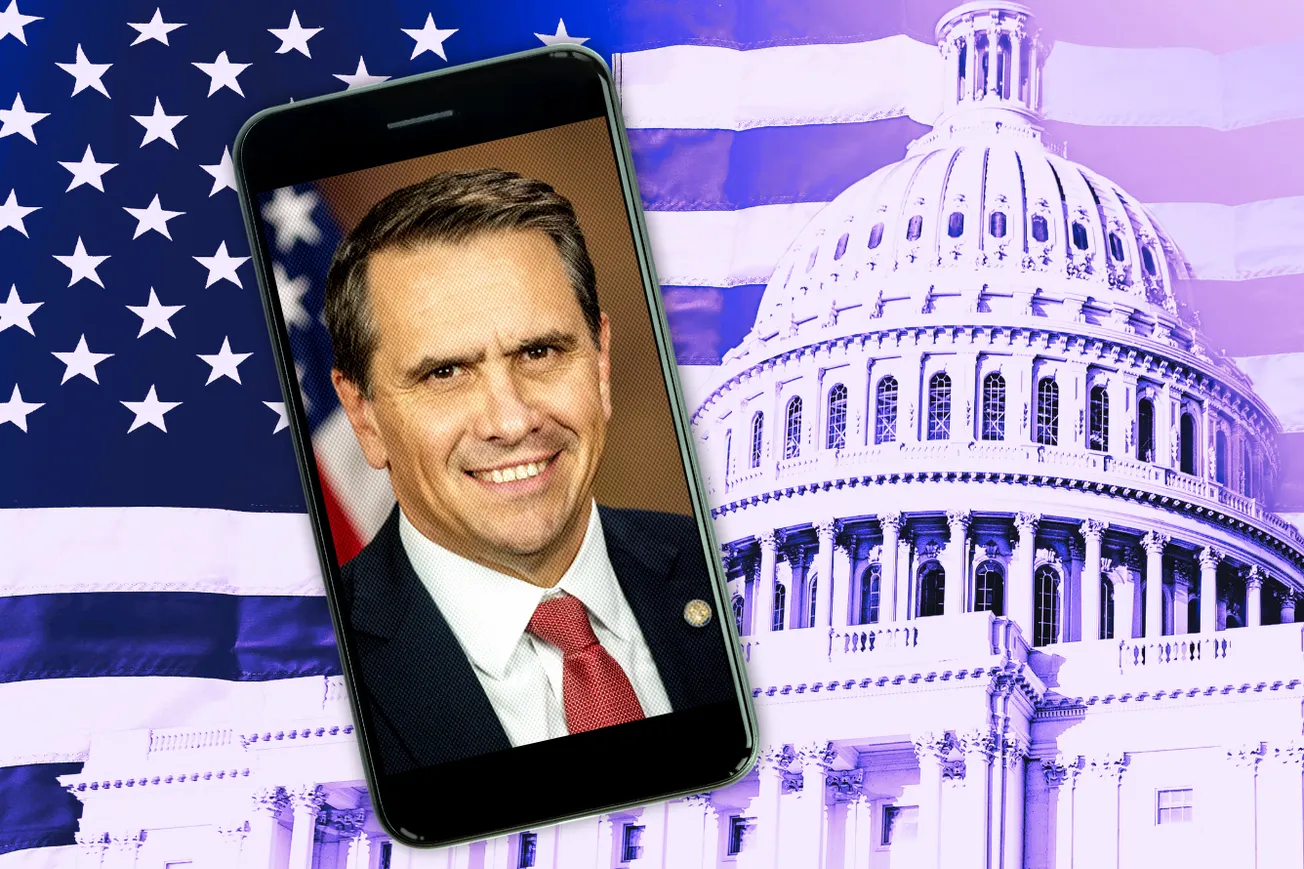
Update 8/10/26: The Senate confirmed Todd Blanche as Attorney General by a vote of 50 to 49 around 4am Saturday.
In now-deleted audio uploaded to YouTube, Acting Attorney General Todd Blanche told religious activists that the Trump administration is working to end telemedicine prescriptions and mail delivery of abortion pills nationwide. The Senate may vote on Blanche’s nomination to officially assume the role of Attorney General as early as this week.
During a private call hosted by the White House Faith Office on July 30, Blanche lamented how long it was taking to restrict abortion access, but said the Department of Justice (DOJ) was working with health agencies and the White House, and that changes were coming "soon." A faith group called Intercessors for America posted audio from the call on YouTube but removed it after Politico reported on Blanche’s comments.
Blanche, Trump’s former personal lawyer, acknowledged that the White House was still tackling “the pro-abortion work” of the Biden administration. This would seem to reference the fact that, in 2021, the Food and Drug Administration (FDA) eased restrictions to allow telemedicine prescriptions of mifepristone, the first of two drugs used in a typical medication abortion regimen. The agency made this change permanent in 2023. “Rest assured that we're working, you know, hand in hand with HHS and the FDA and the White House and President Trump's team to get permanent solutions so that the Dobbs decision becomes permanent in every single state,” he said.
Blanche called out telemedicine abortion specifically. “If states have said, ‘We are going to protect the unborn, and we're going to protect every life from the moment of conception,’ we're putting practices and policies in place so that other states and other organizations can't attack that,” he said. “They can't, you know, do things like they're doing with mailing and mail-order drugs.” This echoes language from a May dissent in which Justice Samuel Alito suggested that telehealth prescriptions of mifepristone are part of “a scheme to undermine our decision in Dobbs.”
The acting AG seemingly empathized with conservatives’ frustration that people who live where abortion is banned can order pills from doctors in other states: Eight states have telehealth “shield” laws, under which clinicians provide nearly 15,000 medication abortions per month. Blanche told them to hold tight: “It's been 19 months [of Trump’s second term], and we don't have complete victory yet, but we will have victory, and victory will be soon, and it will be permanent.”
Samuel Bagenstos, a University of Michigan law professor and former general counsel to the Department of Health and Human Services (HHS), told Autonomy News that Dobbs already applies in every state—by letting states choose whether to ban abortion or not. Blanche seems to suggest something different: that “prohibitions of abortion will apply in every single state,” Bagenstos said.
The acting AG’s statement, which Bagenstos called “ambiguous” and “foreboding,” doesn’t make clear what form restrictions might take. However, conservatives have made three main suggestions: the FDA could reinstate medically unnecessary in-person appointments for mifepristone, it could revoke the drug's approval altogether, or the DOJ could reinterpret the 19th-century Comstock Act to ban the shipment of abortion pills. This would apply to both mifepristone and misoprostol, the second drug in the FDA-approved regimen.
Here is the now-deleted(!) audio of acting Attorney General Todd Blanche pledging that the Trump administration will end telemedicine prescriptions of abortion pills nationwide 
— Susan Rinkunas (@susanrinkunas.com) August 4, 2026 at 9:02 PM
[image or embed]
The Trump administration has tried to keep abortion access out of the headlines in advance of the midterm elections, but abortion opponents continue to press the issue. For example, multiple states sued the FDA in an attempt to reimpose in-person appointments for mifepristone, and lawmakers like Missouri Senator Josh Hawley demanded that the agency conduct an unnecessary safety “review” of the drug. The FDA relented on the review, but former FDA chief Marty Makary reportedly slow-walked the process so that it wouldn’t be complete until after the midterms. The agency then used the existence of the review to ask federal judges in three states to pause the lawsuits. As a result, the FDA must provide a status update on its work to a Louisiana judge in early October.
“Everybody has to assume that, as soon as the midterm elections are over, the Trump administration is going to take some serious steps to restrict access to medication abortion,” Bagenstos said. “The only question is, what are the steps they're going to take?”
He predicts that, at a minimum, the FDA will move to end telemedicine prescriptions, which would force people even in states with legal abortion to travel to a clinic to get mifepristone.
Blanche’s words could come back to bite
If Blanche is hinting at FDA policy changes, a potential silver lining is that these openly political comments could be used against the administration in the lawsuits that reproductive freedom groups would inevitably file. “Every time someone like Todd Blanche makes a statement to anti-abortion groups that FDA's actions are somehow being responsive to anti-abortion politics instead of science, that undermines the potential defense that they will have in court of any FDA action,” Bagenstos said. “He is making it harder to defend in court a potential FDA action to ban telehealth or to pull the approval of mifepristone.”
Bagenstos said that the FDA is legally required to act according to scientific evidence, and that there’s no legitimate justification for changing regulations around mifepristone. If there is a strong indication that the FDA acted for reasons other than scientific ones—like, say, a political agenda—a judge could throw out any changes for violating the Administrative Procedure Act (APA), which governs how federal agencies function. The legal test a judge would apply is whether agency actions could be considered “arbitrary or capricious.” That means an agency acted outside the scope of its duties or didn’t follow proper procedure. The Trump administration is no stranger to this type of fight: A coalition of states is currently suing the White House under the APA over changes it made to insurance coverage of birth control in 2017.
Blanche’s comments on the call—which suggest that the DOJ is taking a direct hand in decisions that should belong to the FDA—are a prime example of evidence that could be used to sue over a future change to mifepristone, Bagenstos said. “DOJ knows nothing about scientific evidence,” he said.
Blanche is “responding to the anti-abortion agenda of the president and the president's political supporters,” he added. “All of this stuff is fodder that will be used to challenge whatever FDA does.”
Blanche knows that the administration could get sued under the APA: He even referred to the possibility during his July confirmation hearing. The purpose of the FDA’s nonsense "review" of mifepristone’s safety, he told Senator Josh Hawley, was to have something to point to in the Louisiana litigation, or in APA challenges filed over future changes to mifepristone’s availability. “We have to have studies that we can defend in court,” he said. “We have to be able to say to a judge, probably in this district, that our change was not arbitrary and capricious.”
It’s possible that Blanche only made his legally risky comments about impending “complete victory” on the call because abortion opponents are getting impatient and he wanted to signal to conservatives that he had their backs, Bagenstos said. Still, the legal process is slow, and the Supreme Court has often allowed Trump administration policies to take effect while litigation continues—which could be disastrous for abortion access. “Litigation will happen and might in the end protect the rights of women here, but it might not,” given the makeup of the Supreme Court, Bagenstos said. “In any event, it will take time and cause a lot of disruption.”
In other words, a change in FDA policy on mifepristone could go into effect while legal battles play out, leaving abortion seekers in the lurch in the meantime.
A second drug could also be at risk
Blanche didn’t use the word “mifepristone” on the call, instead referring only to “mail-order drugs.” That careful word choice could be meaningful. Should the FDA restrict access to mifepristone, abortion providers have a backup plan ready to keep telehealth abortions available: Because misoprostol is also safe and effective on its own, providers are prepared to switch to prescribing misoprostol-only abortions. This method is very common around the world, though it does take longer and can involve more side effects.
However, misoprostol-only abortion is technically an off-label use of the drug—meaning a use other than what the FDA explicitly approved it for. And Trump’s DOJ has shown a hostility toward off-label prescriptions in medical care that it opposes. Justice Department lawyers claimed in March that gender-affirming care providers who prescribe hormones or puberty blockers for transgender people could be committing “conspiracy [with manufacturers] to engage in this kind of off-label promotion.”
Plus, last month, Hawley wrote a letter to Blanche demanding that the DOJ open a criminal investigation into the abortion pill information service Plan C. The website directs users to various medication abortion options, including “shield” law providers in the U.S. and online pharmacies that ship pills from overseas. Hawley alleged that Plan C may be conspiring with mifepristone manufacturers to introduce “misbranded” drugs into the U.S. His letter cites as evidence the fact that Plan C lists services offering abortion pills for use up to 14 weeks of pregnancy, when the FDA-approved use is only up to 10 weeks—that’s an off-label use of mifepristone. As Autonomy News explained at the time:
If the Trump administration’s position is that a provider who prescribes off-label medications for a purpose it doesn’t like is engaging in conspiracy to commit healthcare fraud, that could be the end of misoprostol-only abortion before it even gets started.
In this scenario, there will still be community networks providing abortion pills outside the health system and services that ship pills from overseas. But nearly 30 percent of all clinician-provided abortions in the U.S. are currently done via telehealth—tens of thousands per month. It’s not clear whether existing community networks could absorb this volume, or whether struggling brick and mortar clinics could, either.
A zombie rears its head
Additionally, Blanche’s DOJ could decide to reinterpret a 19th-century anti-obscenity law called the Comstock Act to ban the shipment of drugs or devices used for abortion. Far-right activists have been trying since Dobbs to revive the law, which they believe could be weaponized as a ban on medication abortion, if not all abortion procedures. Blanche said during his July confirmation hearing that he would review a Biden-era legal opinion on Comstock. This week, DOJ confirmed to Politico that a “thorough review” was already underway.
Louisiana’s lawsuit against the FDA argues that prescribing mifepristone via telehealth violates Comstock, and the Fifth Circuit Court of Appeals will hear arguments about that claim in September. In a brief filed late last month, lawyers for Louisiana—including Josh Hawley’s wife, Erin—wrote that “mailing a drug to produce abortion is precisely what the Comstock Act prohibits.”
This legal logic would apply just as equally to misoprostol as it does to mifepristone, Bagenstos said. “It wouldn't matter what drug. It could be misoprostol, could be mifepristone, could be anything,” he said.
The slope gets even more slippery from there: If Comstock applies to drugs, what about devices like clinic supplies? “If they're right about their interpretation of Comstock with respect to drugs, it's really hard to explain why it's not a nationwide ban on abortion,” Bagenstos said.
Any new interpretation of Comstock would also be the subject of litigation, Bagenstos said, and we just have to wait and see which path the administration takes. “Watch out after November,” he said, “because they will have nothing to lose at that point.”
This story was edited by Garnet Henderson and copy edited and fact checked by Hannah McAlilly.
Follow Autonomy News on Instagram, Bluesky, TikTok, Threads, and LinkedIn.